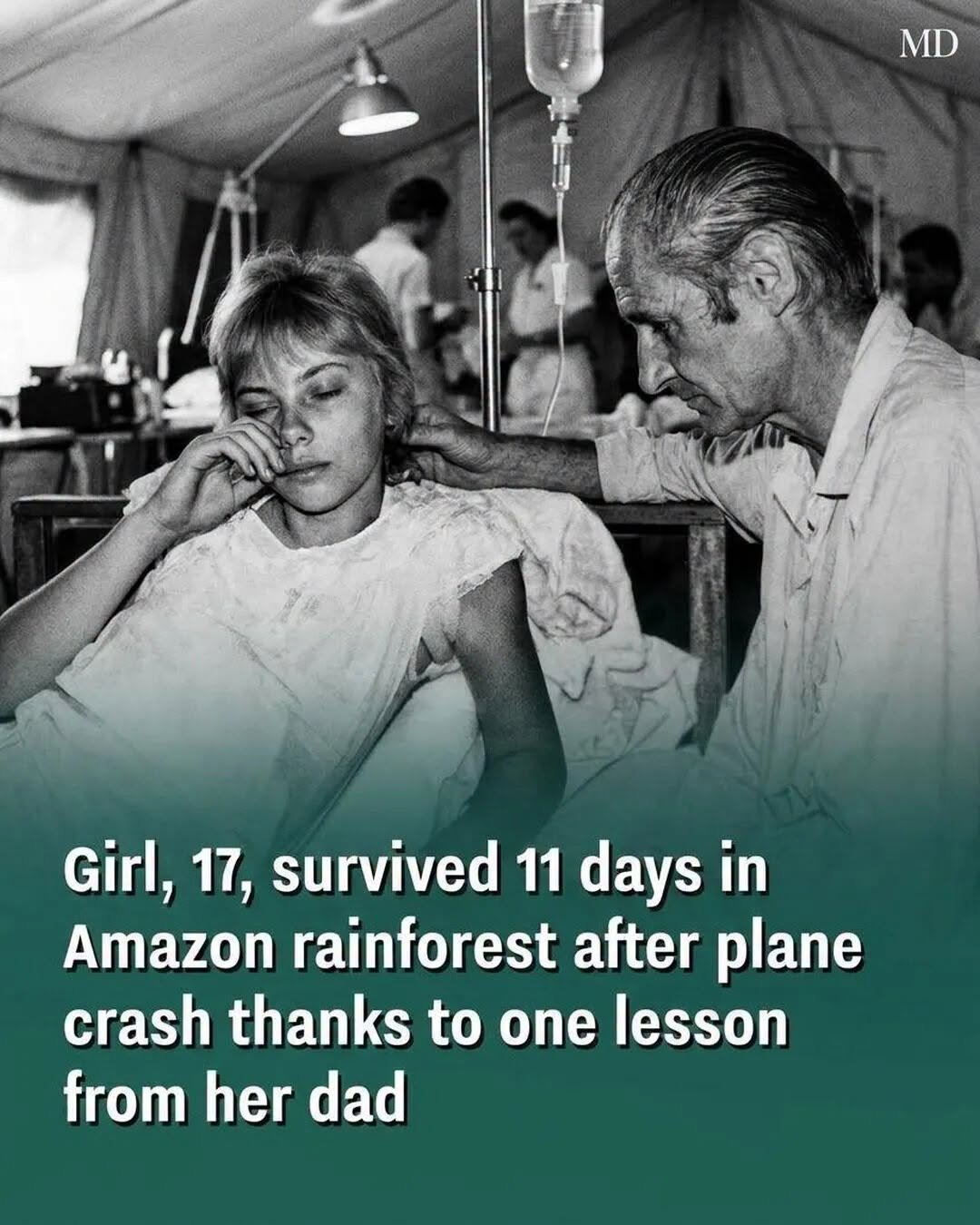
The aircraft broke apart above the Amazon rainforest, and 17-year-old Juliane Koepcke suddenly found herself plunging toward the trees, still strapped into her seat. Moments earlier, she had been sitting beside her mother as their flight encountered a violent thunderstorm over Peru on Christmas Eve in 1971. Lightning flashed outside, the plane shook violently, and her mother delivered words Juliane would never forget: “That is the end, it’s all over.”
Then the aircraft entered a terrifying dive, and Juliane lost consciousness during the fall. When she finally woke up, she was injured, disoriented, and surrounded by dense jungle with no clear path to safety. She had survived a fall that should have been impossible, but the real fight for her life was only beginning.
Juliane had been traveling with her mother, Maria, aboard LANSA Flight 508, a flight from Lima to the eastern Peruvian city of Pucallpa. Her parents were German zoologists who had moved to Peru to study wildlife, so Juliane had spent much of her childhood around the rainforest. That experience would prove crucial in the days ahead.
The aircraft had been struck by lightning during a severe storm. It broke apart in midair, scattering passengers and debris over the forest. Juliane later recalled falling through the sky, still attached to a row of seats. Somehow, the trees and the circumstances of the crash helped cushion her descent.
When she regained consciousness, she discovered that she had survived with a broken collarbone, a deep cut on her arm, a swollen eye, and numerous bruises. One of her sandals was missing, and her glasses were gone. She was alone in one of the most challenging environments on Earth.
At first, Juliane searched for her mother, calling out and hoping to hear a familiar voice. But there was no answer. She had no food, no proper equipment, and no way to contact anyone. The thick canopy blocked much of the sunlight, making it difficult to judge the time of day, while insects and the constant sounds of the forest surrounded her.
Yet Juliane understood something that many people would not have known: in the rainforest, finding water could mean the difference between life and death.
She remembered lessons from her parents about the jungle and began looking for a stream. Rather than wandering aimlessly through the vegetation, she followed the water, knowing that small streams could eventually lead to larger waterways where people might travel.
Her injuries made every movement painful. She had to navigate slippery ground, tangled roots, fallen branches, and muddy banks. At times, she struggled to keep going, but the thought of rescue pushed her forward.
For days, she continued downstream. She found little to eat and survived largely on the water she could access. The wound on her arm became increasingly concerning, and she endured exhaustion, fear, and the constant threat of infection.
Then, after roughly nine or ten days in the jungle, she discovered a small shelter near a stream. Inside, she found fuel and equipment left by local workers. There was no one there, but the shelter offered a sign that people sometimes came to this remote area.
Juliane waited, hoping someone would return.
Eventually, several Peruvian lumber workers arrived. They were astonished to find a teenage girl who had survived a plane crash and managed to cross the rainforest alone. They helped her, treated her injuries as best they could, and arranged for her to be taken by boat to a place where she could receive medical care.
On January 3, 1972, Juliane was rescued and brought to medical assistance. She had survived approximately eleven days in the jungle.
The rescue brought relief, but it also carried heartbreaking news. Juliane learned that she was the only survivor among the 92 people aboard Flight 508, including her mother. Her father, who had remained behind in Peru, was left to face the loss of his wife and the terrifying uncertainty surrounding his daughter’s survival.
Juliane’s story soon attracted international attention. People struggled to comprehend how a teenager could survive a fall from an exploding aircraft and then endure more than a week alone in the Amazon rainforest.
But Juliane never described her survival as a miracle she had achieved through courage alone. Her childhood familiarity with the rainforest, her knowledge of finding water, and the extraordinary circumstances of the crash all played important roles. Even with those advantages, her survival was an astonishing combination of endurance, knowledge, and luck.
In later years, she became a mammalogist, following in the scientific footsteps of her parents. Rather than allowing the tragedy to define her entire life, she returned to the world of research and wildlife that had shaped her childhood.
Her experience also inspired books and documentaries, including the film Wings of Hope, directed by Werner Herzog, who had originally been scheduled to travel on the same flight but changed his plans.
Juliane Koepcke’s story remains one of the most extraordinary survival accounts ever told. At just 17, she faced a catastrophe that took the lives of everyone else aboard her flight, then found the strength and knowledge to navigate one of the world’s most unforgiving environments.
She could not save her mother, and she could not undo the tragedy that had changed her life forever. But she survived, rebuilt her life, and continued pursuing the scientific work she had grown up loving.
Sometimes survival is not about being fearless. It is about taking the next step, even when the way forward is uncertain, and refusing to give up when hope seems impossibly far away.