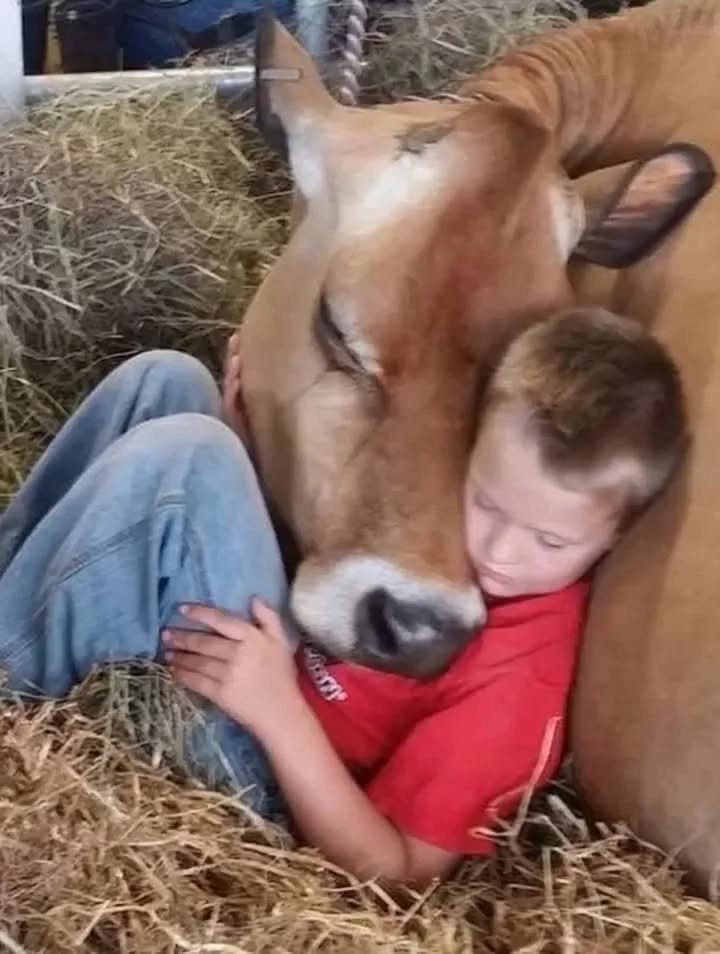
In the quiet, sprawling landscape of our family farm, silence has become a heavy, living thing. My younger brother, Leo, used to be the kind of child who filled every room with noise. He was wild, restless, and perpetually in motion, a blur of energy that neither our parents nor the boundaries of the farm could quite contain. He was the kid who climbed the highest branches of the oak trees and shouted his triumphs to the wind. But that version of Leo vanished last autumn, replaced by a ghost of a boy who refuses to speak above a low, trembling whisper.The change was immediate and absolute following our return from the back acres of the farm late last October. Since that day, Leo has abandoned the comfort of our shared bedroom, refusing to lay his head on a mattress or under a quilt. Instead, he has taken up a permanent residence in the hayloft of the old barn. He spends his nights huddled against Daisy, our gentlest Jersey cow. There is something profoundly unsettling about the sight of him wrapped around her large, warm frame, seeking a solace that the rest of us apparently cannot provide. My mother, ever the optimist, thinks it is a sweet, eccentric bond between a boy and his animal. My father dismisses it with a shrug, calling it a strange phase that will pass with the first frost of winter. But I have always sensed that Leo’s exile to the barn is not about affection—it is about sanctuary.
A few nights ago, driven by a gnawing curiosity and a growing sense of dread, I crept into the barn after the house had gone dark. The air was thick with the scent of dry alfalfa and the rhythmic, heavy breathing of the livestock. I stayed in the shadows, watching as Leo leaned his forehead against Daisy’s velvet-soft neck. He didn’t see me, and in the stillness, I heard him whisper. It was a voice filled with a desperate, crushing weight.
“I didn’t tell them it was me,” he murmured into the cow’s ear. “I know you saw, Daisy. I know you were there, but you didn’t tell either. Thank you for keeping it.”
Daisy didn’t move. She simply blinked her large, liquid eyes—slow and deliberate—as if she were a silent confessor absorbing the sins of a child. I felt a chill that had nothing to do with the night air. Leo wasn’t just sleeping in the barn; he was hiding in plain sight, protected by a witness that lacked the power of speech.
The following afternoon, I finally confronted him behind the grain silo. I expected him to run or to retreat into his usual stony silence, but instead, he crumbled. He didn’t cry out of fear or the dread of being caught; he cried out of pure, exhausted relief. It was as if the secret had become too heavy for his small frame to carry alone. He grabbed my hand with a strength that startled me, his knuckles white and his eyes wide with a frantic urgency.
“Don’t open the red toolbox,” he begged, his voice cracking. “And whatever you do, don’t show them the photo. Please. Promise me.”
I promised him, mostly to get him to let go of my arm, but the words “red toolbox” echoed in my mind for the rest of the day. My father has dozens of toolboxes, most of them scattered throughout the workshop and the tractor shed. I spent the morning searching, moving through the rust and the grease of the farm’s mechanical history. I finally found it tucked away in the crawlspace beneath the floorboards of the tool shed, hidden under a pile of moth-eaten burlap sacks. It was an old, battered metal chest, the red paint flaking off in jagged scales.
When I finally pried the lid open this morning, the first thing I saw was a Polaroid photograph, its edges yellowed and curled. I picked it up with trembling fingers. It was a shot taken in the back woods, near the old stone well that had been boarded up years ago for safety. In the frame, the light was filtered and sickly, catching the silhouette of someone standing at the edge of the pit. Even through the graininess of the film, I recognized the jacket. It was Leo’s favorite blue windbreaker. But it wasn’t the figure that made my stomach turn; it was what lay on the ground at the figure’s feet.
Below the photograph, tucked beneath a heavy set of iron wrenches, was a collection of objects that made no sense: a single silver cufflink, a set of keys to a car we don’t own, and a small, leather-bound diary that didn’t belong to anyone in our family.