
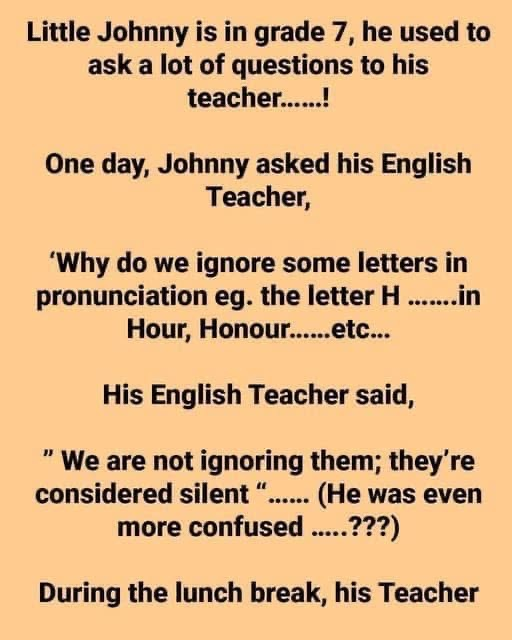
Little Johnny and the Silent Letter
Little Johnny was in Grade Seven, and everyone at Greenfield Academy knew two things about him.
First, he was extremely curious.
Second, once he asked a question, the lesson rarely returned to its original topic.
Johnny did not ask ordinary questions such as, “Will this be on the test?” or “May I sharpen my pencil?” His questions were much more dangerous.
During science class, he once asked, “If humans are mostly water, why don’t we spill when we run?”
In geography, he asked, “If the world is round, why are maps rectangular?”
During mathematics, he stared at the board for five minutes before raising his hand.
“Sir, if zero means nothing, why does adding it to ten make one hundred?”
The mathematics teacher removed his glasses, rubbed his eyes, and quietly asked the class to open their textbooks.
Johnny’s teachers admired his desire to learn, although some of them had begun taking deep breaths whenever they saw his hand rise.
His English teacher, Mrs. Williams, was especially patient with him. She had taught for fifteen years and believed that no sincere question should be discouraged. She also believed that grammar, spelling, and pronunciation could be explained logically.
Little Johnny was about to challenge that belief.
One Tuesday morning, Mrs. Williams entered the classroom carrying a pile of books and a packed lunch in a blue container.
“Good morning, class,” she said.
“Good morning, Mrs. Williams,” the students replied.
She wrote the day’s topic on the board:
Silent Letters
“Today,” she announced, “we will learn about letters that are written but not pronounced.”
Johnny’s hand went up immediately.
Mrs. Williams had not even put down the chalk.
“Yes, Johnny?”
“Madam, how can a letter be silent? Letters don’t talk.”
Several students giggled.
Mrs. Williams smiled. “A silent letter is a letter that appears in the spelling of a word but is not heard when we pronounce it.”
She wrote several examples on the board:
Knife. Knee. Write. Hour. Honour.
“In ‘knife,’ the letter K is silent,” she explained. “In ‘write,’ the W is silent. In ‘hour’ and ‘honour,’ the H is silent.”
Johnny frowned at the board.
“Why do we ignore those letters?” he asked.
“We do not ignore them,” Mrs. Williams replied. “They are simply considered silent.”
Johnny looked even more confused.
“But if they are silent, why are they there?”
“Many English words have developed over hundreds of years,” she explained. “Pronunciation changed, but spelling sometimes remained the same.”
Johnny continued staring at the examples.
“So the letters used to make sounds?”
“In some cases, yes.”
“And then they stopped?”
“That is one way to think about it.”
“Did they get tired?”
The class burst into laughter.
Mrs. Williams waited until everyone settled down.
“No, Johnny. Languages change naturally over time.”
Johnny nodded slowly, although his expression suggested that the explanation had created more questions than answers.
He pointed at the board. “In the word ‘knife,’ the K is silent?”
“Yes.”
“In ‘write,’ the W is silent?”
“Yes.”
“And in ‘hour,’ the H is silent?”
“Correct.”
“What about ‘house’?”
“The H is pronounced in ‘house.’”
“What about ‘honest’?”
“The H is silent.”
“What about ‘hospital’?”
“The H is pronounced.”
Johnny leaned back in his chair.
“So how are we supposed to know when H wants to work?”
Mrs. Williams paused.
“You learn through practice,” she said.
Johnny wrote something in his notebook.
The student beside him, Daniel, whispered, “What are you writing?”
“A warning,” Johnny replied. “Never trust the letter H.”
For the rest of the lesson, Mrs. Williams explained other silent letters. The class learned about the silent B in “comb,” the silent L in “calm,” and the silent T in “castle.”
Johnny listened carefully.
When Mrs. Williams wrote the word “island,” he raised his hand again.
“The S is silent,” she said before he could speak.
Johnny lowered his hand.
At last, the lunch bell rang.
The students rushed outside, but Johnny remained behind to finish copying the examples. Mrs. Williams stayed at her desk, marking exercise books.
After a few minutes, she opened her bag and removed the blue lunch container.
“Oh dear,” she said. “My lunch is cold.”
The school cafeteria had a microwave that students and teachers could use. Mrs. Williams looked at Johnny, who was still writing.
“Johnny, would you please do me a favor?”
“Yes, Madam.”
“Take my lunch to the cafeteria and heat it for two minutes.”
She handed him the container.
“Heat it?” Johnny repeated.
“Yes. Please be careful, and bring it back when it is warm.”
Johnny accepted the container and walked toward the cafeteria.
Inside, the lunchroom was crowded. Students stood in line for sandwiches, rice, fruit, and juice. The smell of food filled the air.
Johnny placed the blue container on a table and looked at it.
Then he remembered the morning’s lesson.
Mrs. Williams had clearly said that the H in “hour” and “honour” was silent.
Johnny slowly pronounced the instruction in his mind.
“Heat it.”
He removed the H.
“Eat it.”
His eyes widened.
“Ah,” he whispered. “English.”
He opened the container.
Inside was roast chicken, seasoned rice, vegetables, and a small piece of chocolate cake. It looked far better than the plain cheese sandwich Johnny’s mother had packed for him.
He hesitated for approximately three seconds.
Then he found a spoon.
Johnny began with the rice. It was delicious. Next came the chicken, followed by the vegetables. He finished the meal carefully and saved the cake for last.
When the container was empty, he wiped the edge with a napkin, closed the lid, and returned to the classroom.
Mrs. Williams was arranging papers when Johnny placed the container on her desk.
“That was quick,” she said.
“Yes, Madam.”
She touched the container.
“It doesn’t feel warm.”
Johnny said nothing.
Mrs. Williams opened it.
She stared at the empty container.
Then she looked at Johnny.
Then she looked inside the container again, as though the food might have hidden under the lid.
“Johnny,” she said slowly, “where is my lunch?”
“I followed your instructions, Madam.”
“My instructions?”
“Yes.”
“I told you to heat my food.”
Johnny nodded confidently.
“Exactly.”
Mrs. Williams held up the empty container. “Then why did you eat it?”
Johnny looked genuinely surprised.
“Madam, this morning you taught us that the H is silent.”
The classroom became completely still.
Johnny continued, “So when you said ‘heat it,’ I ignored the sound of H.”
“I told you not to ignore it!”
“You said silent letters are not pronounced.”
“In certain words, Johnny!”
“But how was I supposed to know that H wanted to work during lunch?”
Daniel covered his mouth, but a loud snort escaped. Within seconds, the entire class was laughing.
Even students in the corridor stopped to see what had happened.
Mrs. Williams closed her eyes and took a long breath.
Johnny waited politely.
Finally, she opened her eyes.
“The H in ‘heat’ is not silent.”
“I understand that now,” Johnny said. “The food explained it very clearly.”
The students laughed even harder.
Mrs. Williams tried to remain serious, but the corner of her mouth began to rise. Soon, even she was laughing.
“You owe me lunch,” she said.
Johnny immediately handed her his cheese sandwich.
“It is not roast chicken,” he admitted, “but all the letters are pronounced.”
From that day forward, Mrs. Williams gave Johnny extremely precise instructions.
She never asked him to “write” something without pointing at the paper.
She never told him to “knead” dough without demonstrating.
And she certainly never again asked him to heat her lunch.
As for Johnny, he finally understood silent letters.
He learned that English was full of rules, exceptions, surprises, and occasional opportunities for chocolate cake.