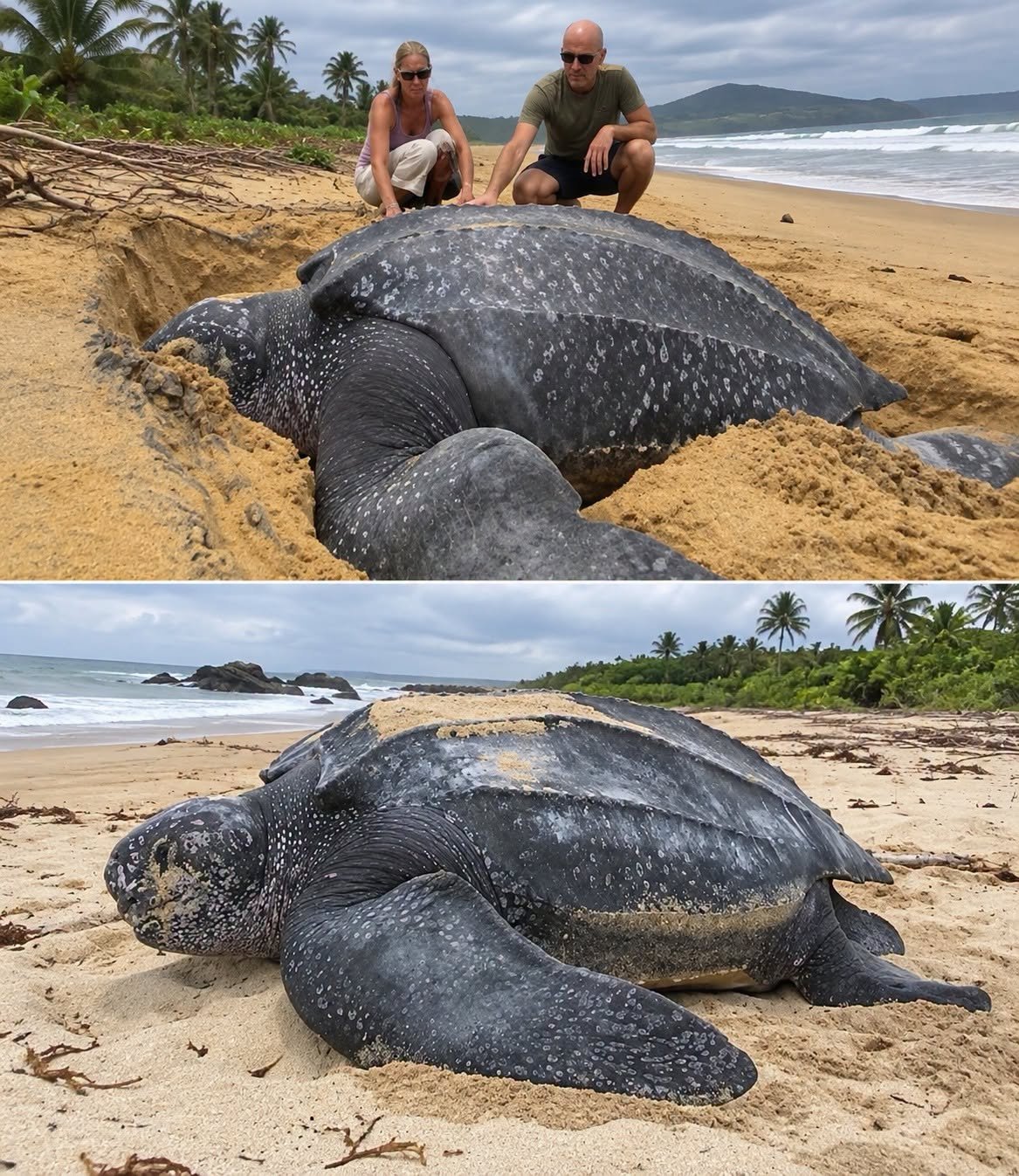
Under the quiet moon of Sanibel Island, a Leatherback sea turtle’s return becomes more than a rare wildlife sighting; it is a living thread tying millions of years of evolution to a single fragile night. Her struggle up the sand, the careful shaping of a nest, and her slow disappearance back into the waves reveal a life built on impossible journeys and precise timing. Long after she is gone, the beach keeps her secret. Beneath the surface, uncounted hatchlings develop in darkness, their fate shaped by temperature, tides, weather, and the choices humans make nearby.
Every light left burning, every vehicle on the sand, every careless step near a marked nest can tilt the balance against them. Yet the opposite is also true: distance, darkness, and respect give this ancient ritual room to succeed. On beaches like Sanibel, protection is not grand or complicated. It is the quiet decision to watch from afar and let a wild story older than humanity continue unbroken.
Leatherbacks are the largest living sea turtles, and their journeys can span thousands of miles across open ocean. Females return to nesting beaches repeatedly, often years apart, carrying within them the extraordinary ability to navigate back toward places connected to their reproductive cycle. When she finally reaches the shoreline, there is no audience waiting for her—only moonlight, waves, and instinct.
She chooses a stretch of sand and begins to dig, moving enormous flippers with deliberate patience. The work is exhausting, but every movement has a purpose. Once the nest is deep enough, she deposits her eggs, covers them carefully, and smooths the surrounding sand. To a passing observer, the beach may appear unchanged. But beneath it, a new generation has begun.
Weeks later, the hatchlings will face their own extraordinary challenge. They must emerge from the nest, find the surface, and cross the beach toward the ocean while avoiding predators, obstacles, and artificial lights that can draw them away from the water. Their journey is measured in minutes, but its consequences can last a lifetime.
That is why a nesting turtle should never be approached, surrounded, touched, or illuminated with bright lights. Keeping a respectful distance, following local beach regulations, avoiding marked nesting areas, and leaving trash behind are small actions with meaningful consequences.
The mother turtle eventually returns to the sea, leaving behind only tracks in the sand and a hidden nest beneath her path. By morning, the marks may be softened by wind and tide. But the story continues underground.
For a moment, one ancient traveler connected the ocean, the beach, and the generations that came before her. Then the waves closed behind her, and the darkness became quiet again.
Sometimes protecting wildlife means doing nothing at all—standing back, turning off the lights, and giving nature the space to finish what it started.