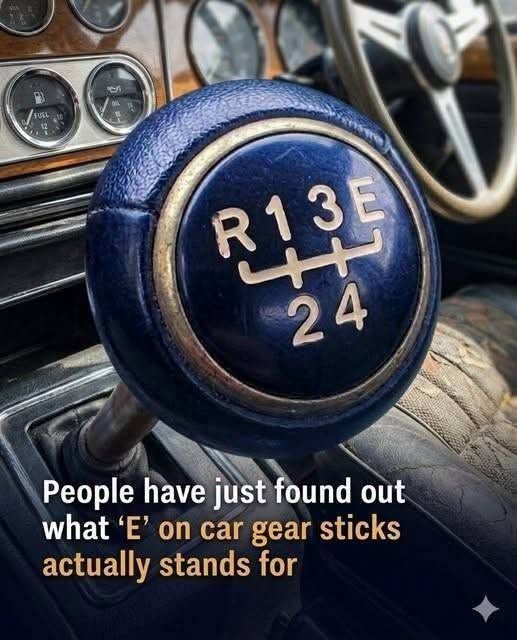
Today’s cars hide their secrets in code and touchscreens. But once, a single mysterious letter on a gear lever could change everything. Tucked beside P, R, and D, that lonely “E” promised something drivers desperately wanted—but few truly understood.
Long before software silently optimized every drop of fuel, the “E” on older gear selectors made efficiency a conscious choice. Selecting it transformed the way a car behaved: shifts came earlier, revs stayed lower, and the engine stopped straining for speed. Acceleration softened, the ride calmed, and drivers felt the difference in their hands, feet, and fuel receipts. For many, it was the first time a car openly asked, “Do you want power, or do you want to save?”
Why Did Cars Have an “E” Mode?
The exact meaning of “E” depended on the manufacturer and transmission. In many older automatic cars, it stood for Economy and changed the transmission’s shift strategy to favor smoother, lower-rpm driving.
Instead of holding a gear for maximum acceleration, the transmission would generally upshift sooner. The engine could spend more time operating at lower speeds, reducing unnecessary fuel consumption during ordinary driving.
It was especially useful for commuters and relaxed highway driving. The trade-off was simple: you gained efficiency but gave up some of the eager response you might want when accelerating hard.
It Wasn’t a Magic Fuel-Saving Button
Despite the mystery surrounding the letter, selecting “E” couldn’t magically make a car economical under every condition.
Your driving habits still mattered. Rapid acceleration, heavy loads, steep hills, frequent stops, and high speeds could all increase fuel consumption. The mode simply encouraged the vehicle to behave more economically.
In other words, the driver still had the final say.
That is part of what made older cars interesting. A small switch or letter could give the driver a noticeable mechanical change instead of hiding everything behind software.
What Happened to the “E”?
As automatic transmissions became more sophisticated, manufacturers found better ways to achieve the same goal. Electronic controls could monitor throttle position, speed, engine load, temperature, and other conditions continuously.
Rather than asking drivers to select an obvious “E,” newer vehicles could automatically decide when an early shift made sense.
Eventually, the familiar letter became less common. In its place came labels such as Eco, Normal, and Sport, along with increasingly intelligent transmission programming.
The technology changed, but the idea remained remarkably similar.
From Gasoline to Electric
Then came another interesting twist.
As electric vehicles became mainstream, energy efficiency once again became a visible part of the driving experience. Some EVs use an “E” designation for particular driving or energy-related functions, while others rely on terms such as Eco, regenerative braking, or efficiency modes.
Electric cars approach the problem differently because electric motors don’t use traditional multi-speed automatic transmissions in the same way most gasoline cars do. Instead, efficiency can be influenced through motor output, regenerative braking, climate control, acceleration response, and battery management.
Yet the philosophy is familiar.
Use less energy. Travel farther.
A Tiny Letter With a Bigger Story
The old “E” may look insignificant today, especially beside modern digital dashboards and drive-mode menus. But it represents an important moment in automotive history.
It was a time when fuel economy was becoming a feature drivers could actively choose rather than something controlled almost entirely in the background.
That little letter also reflected a larger change in the automobile itself. Cars were becoming smarter, transmissions were becoming more sophisticated, and manufacturers were learning how to balance performance with efficiency.
Today, computers make those decisions in milliseconds.
Back then, the driver simply moved a lever.
And perhaps that’s why the mysterious “E” still fascinates car enthusiasts. It wasn’t just a letter on a gear selector. It was a small reminder that driving once involved understanding the machine—and making a deliberate choice about how you wanted it to behave.
From the rumble of an old gasoline engine to the near-silent hum of an electric motor, the goal has remained surprisingly constant:
Get where you’re going while wasting as little energy as possible.
A single “E” helped tell that story.