
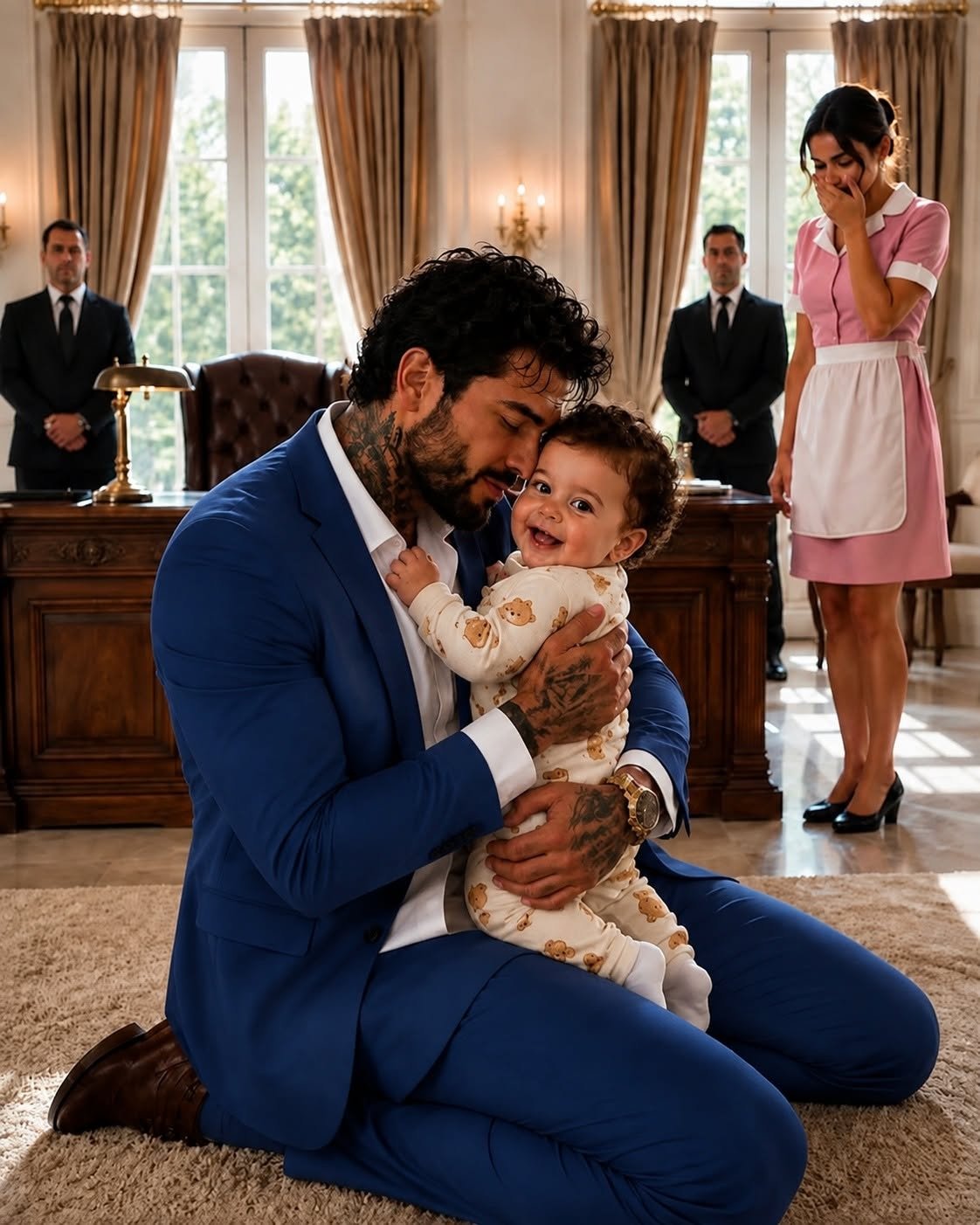
PART 2
“Don’t ask me that.”
Elena’s words were barely louder than Leo’s breathing.
For several seconds, nobody in my office moved.
Dominic still stood near the bookcase. Lorenzo remained beside my desk, though he was no longer on his knees. At some point during those strange, suspended moments, he had pushed himself upright.
The entire room had changed.
Minutes earlier, it had been filled with suspicion and anger. Now all of that seemed absurdly distant.
I looked down at the baby against my chest.
Leo had become fascinated with the silver button on my jacket. He pinched it between his small fingers, turned it, then looked up at me as though he expected praise for discovering it.
Mateo used to do that.
Not with buttons.
With my watch.
Every morning before I left home, he would sit on the edge of my bed and turn the crown of my watch between two fingers.
“You’re making me late,” I would tell him.
“You’re always late,” he would answer.
He had been seven when he died.
Seven years old and already capable of defeating every argument I made.
My throat tightened.
Leo was not Mateo.
I knew that.
Of course I knew it.
But grief did not always listen to reason.
“Elena,” I said again, more quietly.
She folded her arms across herself.
“Please.”
This time I heard what was underneath the word.
Not guilt.
Fear.
But not fear that I would hurt her.
Fear that something she had spent years holding together was about to come apart.
I turned toward Dominic.
“Put the gun away.”
He stared at me.
“Boss?”
“You heard me.”
Dominic immediately removed the magazine, cleared the weapon, and placed it inside the wall safe behind the painting.
Then I looked at Lorenzo.
His swollen lip made me ashamed.
Not because I had struck him—I hadn’t—but because I had allowed a room to exist in which people believed violence was the natural next step.
“Go home, Lorenzo.”
He hesitated.
“What about what we were discussing?”
“We’ll discuss it tomorrow.”
“Alessandro—”
“Tomorrow.”
His expression changed when I used my own name instead of demanding he call me boss.
Lorenzo gave a slow nod.
Dominic opened the door for him.
Before leaving, Lorenzo glanced at Leo.
Then at me.
Something like understanding passed over his face.
“Tomorrow,” he agreed.
Dominic remained.
I looked at him.
He lifted both hands slightly.
“I’m going.”
He stopped at the doorway.
“You need anything?”
I nearly said no.
It was the answer I had given for three years.
No, I don’t need anything.
No, don’t wait up.
No, don’t ask.
No, don’t mention Mateo.
No, don’t touch his room.
No, don’t say his name unless I say it first.
But Leo’s fingers were wrapped around mine.
And Elena was standing in front of me looking as though one wrong sentence might send her running.
“Yes,” I said.
Dominic waited.
“Make sure nobody disturbs us.”
His gaze softened.
“Of course.”
He closed the door behind him.
For the first time, Elena and I were alone.
Except for Leo.
I crossed to the leather sofa near the windows and sat down. Leo immediately twisted around in my arms, curious about everything.
The decanter.
The curtains.
The brass lamp.
The shattered glass on the floor.
I shifted him away from that side of the room.
“Careful, piccolo.”
The old endearment escaped before I could stop it.
Elena closed her eyes.
I saw pain on her face.
Not anger.
Pain.
“Elena,” I said. “Come sit down.”
“I’d rather stand.”
“Then stand.”
She seemed surprised.
Perhaps three years earlier I would have ordered her.
That realization bothered me more than I wanted to admit.
I looked at Leo again.
“Who is his father?”
Elena drew in a breath.
Then she shook her head.
“You’re asking the wrong question.”
I looked up sharply.
“What does that mean?”
“The reason Leo looks like your son isn’t his father.”
She paused.
“It’s me.”
I stared at her.
She wiped her palms against her skirt.
“My mother’s name was Clara Bell.”
The name meant nothing to me.
“At least,” she continued, “that was the name she used most of her life.”
I waited.
Elena swallowed.
“Before she died, she gave me a box. There were letters inside. Old photographs. Documents.”
Something cold moved through me.
“What documents?”
She did not answer immediately.
Instead she walked toward the door.
My entire body tensed.
“Elena.”
“I’m not leaving.”
She looked back at me.
“They’re in my room.”
I studied her face.
For two and a half years, Elena had worked inside my home.
She had never stolen.
Never lied about money.
Never asked for favors.
Never once used my name to gain anything.
She took care of the house with a quiet competence that made her nearly invisible when she wanted to be.
And now I realized how little I actually knew about her.
“Bring them.”
She hesitated.
Then she looked at Leo.
“He stays with you?”
The question struck me unexpectedly.
She trusted me with him.
Or perhaps, despite everything, she had always trusted me with him.
“I won’t move from this sofa.”
Elena nodded.
She left.
Leo watched the closed door for three seconds.
Then apparently decided I was acceptable company.
He grabbed my tie.
“No.”
He pulled harder.
I almost laughed.
“You’re strong.”
He made a pleased sound.
“You know, your mother is going to blame me if you ruin this.”
Leo answered by putting the silk tie into his mouth.
I removed it gently.
“That cost more than your stroller.”
He laughed.
And there it was again.
That awful, beautiful ache.
For one second I could see another child on my knee.
Older.
Louder.
Impatient.
Mateo leaning backward in my arms while Sofia shouted from downstairs that we were both going to be late.
I closed my eyes.
Three years.
Three years of building walls around every memory because I had believed that remembering him would destroy me.
Instead I was beginning to understand that refusing to remember him had destroyed parts of me anyway.
Leo patted my cheek.
I opened my eyes.
He smiled.
“No,” I whispered.
He blinked.
“You’re Leo.”
Saying it mattered.
“You are Leo.”
He had Mateo’s dark curls.
He had Mateo’s eyes.
He had that impossible crescent beneath his ear.
But he was not a ghost.
He was a baby sitting safely in my arms, curious about my tie.
And he deserved to be seen for himself.
Elena returned carrying a small wooden box.
She sat across from me this time.
The box was old, made of walnut, with scratches near the brass latch.
“My mother kept this in her closet,” she said. “I didn’t know it existed until she became ill.”
She opened it.
Inside were photographs tied with ribbon, several envelopes, and a folded document.
Elena handed me the photograph on top.
A young woman stood beside a lake.
Dark hair.
Narrow shoulders.
A shy smile.
Beside her stood a man I recognized immediately.
My father.
Vittorio Moretti.
He could not have been older than twenty-four.
I stared at the picture.
My father had always seemed old to me.
Even in photographs from my childhood, he had carried the sternness of a man who believed smiling gave away too much.
But here he was laughing.
One arm rested around the young woman’s shoulders.
I turned the photograph over.
A date had been written on the back.
Thirty-two years earlier.
Before my parents married.
“My mother,” Elena said.
I looked up.
She nodded.
“They were together for almost two years.”
My fingers tightened around the photograph.
“She never told me who he was when I was growing up. She only said my father was someone she had loved and that circumstances separated them.”
“What circumstances?”
“His family.”
That I could believe.
My grandfather had controlled his children as if affection were another form of business.
Elena continued carefully.
“My mother became pregnant shortly before your father left for Italy with his family. She wrote to him. The letters were returned.”
“Why?”
“She never knew.”
I did.
My grandfather.
He would have intercepted them without hesitation if he believed a young woman threatened the future he had chosen for his son.
Elena gave me another photograph.
My father was holding a newborn baby.
Elena.
He was older in that picture.
Perhaps thirty.
Which made no sense.
“He came back?” I asked.
“Once.”
“When?”
“When I was six months old.”
I looked at her.
“He knew about you?”
“For one day.”
She gave a small, sad smile.
“He found my mother again years after they separated. By then he was married to your mother, and you had already been born.”
The room seemed to tilt.
“So my father knew he had a daughter.”
“Yes.”
“And he never told me.”
“No.”
The answer should have made me angry.
Instead I felt tired.
There had been too many secrets in my family.
Too many men who believed silence was a form of protection.
“Why didn’t your mother contact him again?”
“She did.”
Elena reached into the box.
“She refused money. She refused to interfere with his marriage. She told him that if he wanted to know me, he had to do it honestly.”
My father had apparently failed that test.
“He wrote to her over the years,” Elena said. “But they never saw each other again.”
“Why?”
“I don’t know.”
I looked at the baby sleeping now against my chest.
Leo’s small fist had curled into my jacket.
The resemblance suddenly seemed less impossible.
My father’s eyes.
My hair.
Mateo’s chin.
Elena had all of them too, though I had never noticed because I had never truly looked.
She wore her hair pulled back.
Her eyes were softer than mine.
Her features were finer.
But once I knew what to see, I could not stop seeing it.
“Leo’s father?” I asked.
A faint smile appeared through Elena’s anxiety.
“His name is Tomas Alvarez.”
She reached for her phone and showed me a picture.
A kind-looking man stood beside Elena at what appeared to be a neighborhood festival. He had sandy brown hair and a wide smile.
He looked nothing like Leo.
“He teaches music,” Elena said. “We were together for almost two years.”
“Were?”
“We aren’t a couple anymore.”
“Does he see Leo?”
“Every Wednesday and every second weekend. He adores him.”
Some tension left my chest.
“So why the secrecy?”
“Because Tomas wasn’t the secret.”
Elena looked at me.
“I was.”
I handed the phone back.
“Why come here?”
That question hurt her.
I could tell before she answered.
“Because my mother died.”
“I’m sorry.”
“She made me promise I would read everything in the box after she was gone.”
Elena touched one of the envelopes.
“I learned your name. I learned about your father. I learned I had a brother.”
She paused.
“And when I searched for you, the first thing I found wasn’t an article about your businesses.”
Her voice softened.
“It was Mateo’s obituary.”
My breath caught.
“There was a photograph of you standing outside the church.”
She looked down.
“You looked like someone who had forgotten how to remain standing.”
I said nothing.
“I decided I couldn’t appear at your door and say, ‘Hello, your father had another child and I think I’m your sister.’”
“So you applied to work in my house?”
She looked embarrassed.
“When I say it out loud, it sounds terrible.”
“It sounds unusual.”
“I told myself I only wanted to see you once. To know whether my mother had been telling the truth. Then the agency offered me the permanent position.”
“And you stayed.”
“Yes.”
“Why?”
Her eyes filled.
“Because you were alone.”
The answer surprised me.
“You had people around you all the time,” she continued. “Dominic. Staff. Drivers. Assistants. Business partners.”
She shook her head.
“But you were alone.”
I looked toward the windows.
The city lights had begun appearing below us.
“You barely spoke to anyone when you came home. You ate dinner at your desk. You kept Mateo’s bedroom exactly as it was. Sometimes I would hear you stop outside his door, but you never went in.”
I had not known anyone noticed.
“I thought I would tell you when you were doing better,” Elena said.
A sad laugh escaped her.
“Then I realized grief doesn’t work on schedules.”
“And then you became pregnant.”
“Yes.”
“Did you know Leo would look like this?”
“Of course not.”
She glanced at him.
“When he was born, he looked like every newborn baby. Red, furious, and offended by the world.”
Despite myself, I smiled.
Elena smiled too.
“Then his hair darkened. His eyes changed.”
She touched her own cheek.
“And when he was five months old, the birthmark became darker.”
“Why didn’t you leave?”
“I almost did.”
“Why didn’t you?”
“Because this is my job. My home, in some ways. And because leaving suddenly would have created more questions.”
I studied her.
“Were you ever going to tell me?”
“Yes.”
“When?”
“I don’t know.”
At least the answer was honest.
Leo shifted.
Elena immediately leaned forward.
I passed him carefully into her arms.
He settled against her as if nothing unusual had happened.
Watching them made something very clear.
Whatever connection existed between us, Elena was his mother.
No family name, test result, photograph, or inheritance could change that.
“Are you afraid I’ll try to take him from you?”
Her head snapped up.
For a second, she did not answer.
“That thought crossed my mind.”
My stomach tightened.
“I would never.”
“I know that now.”
“But you didn’t know it before.”
She looked at me steadily.
“No.”
I could have been offended.
Instead I thought about the man I had become after Mateo died.
The cold rooms.
The clipped orders.
The silence.
The fear I had mistaken for respect.
I could hardly blame Elena for believing what everyone else believed.
“I’m sorry,” I said.
She blinked.
“For what?”
“For giving you a reason to wonder.”
Something shifted between us then.
Not forgiveness.
We were not there yet.
But perhaps honesty.
I returned my attention to the box.
“Is there anything proving my father was your father?”
Elena nodded.
“There’s a birth certificate, but his name isn’t listed. There are letters. Photographs. My mother had an old blood test from when I was a child, but nothing definitive.”
“Then we can do a DNA test.”
Her face tightened.
“Only if you want one.”
“You don’t?”
“I do.”
She hesitated.
“But I don’t want you thinking I came here because I wanted something.”
“What would you want?”
“A brother.”
The simplicity of the answer silenced me.
Not money.
Not a name.
Not a place in my companies.
A brother.
I looked down at the box again.
There was one envelope beneath the photographs.
Unlike the others, it had never been opened.
The handwriting on the front stopped me.
I knew that handwriting.
I had seen it on birthday cards, contracts, notes left beside breakfast plates.
My father.
Across the front he had written:
For Alessandro.
I looked at Elena.
“You’ve never opened this?”
“No.”
“Why?”
“My mother said it wasn’t mine.”
My hands suddenly felt unsteady.
“When did she get it?”
“She didn’t know. It was inside a larger envelope from your father’s attorney that arrived several months after he died.”
My father had died four years ago.
One year before Mateo.
I slid my finger beneath the flap.
The paper inside was cream-colored, folded twice.
The first lines were enough to make my heart pound.
Alessandro,
There are things a father should tell his son while he is alive.
I failed to do that.
I read on.
Before I met your mother, I loved a woman named Clara.
We had a daughter.
My gaze lifted.
Elena pressed one hand over her mouth.
I continued.
Her name is Elena.
If this letter has reached you, then I lacked the courage or the time to tell you myself.
That sounded exactly like my father.
Proud until the end.
Always certain there would be another day for difficult conversations.
Then I reached the final paragraph.
And everything inside me went still.
You may wonder whether she is truly your sister.
She is.
I saw her as an infant, and I arranged a private test years later when Clara finally permitted it.
The result is with my attorney.
I looked at Elena.
She was crying silently now.
But there was one more sentence.
One sentence my father had underlined.
Alessandro, when you meet her, do not make her pay for my silence.
I lowered the letter.
For a long time, neither of us spoke.
Leo slept peacefully between us.
Finally Elena whispered, “There’s something written on the back.”
I turned the page over.
A final note waited there.
Three lines.
One day Elena may have a child.
If that child looks familiar, do not be frightened.
The Moretti face has always had a habit of returning.
I laughed.
Not because anything was funny.
Because it was so completely, infuriatingly like my father to leave behind an answer four years too late.
Elena stared at me through tears.
“What do we do now?”
For most of my life, I had believed every difficult problem required an immediate decision.
A command.
A strategy.
A winner.
But this was not business.
This was family.
And family, I was beginning to understand, sometimes needed something much simpler.
Time.
I looked at the woman who might be my sister.
Then at the sleeping baby who might be my nephew.
“We start,” I said slowly, “by having breakfast tomorrow.”
Elena blinked.
“Breakfast?”
“Yes.”
“That’s your plan?”
“It’s the only one I have.”
A laugh escaped her.
It was quiet and uncertain, but real.
“Okay.”
“Eight o’clock.”
“I usually start work at seven.”
“Tomorrow you’re not working.”
Her smile disappeared.
I corrected myself immediately.
“I mean—you’re eating with me. Not serving me.”
The smile returned.
“That may take some getting used to.”
“For both of us.”
She stood with Leo.
At the door she stopped.
“Alessandro?”
It was the first time she had ever used my first name.
I felt it.
“Yes?”
She looked down at her son.
“When Leo crawled in here tonight, I thought everything was going to fall apart.”
“So did I.”
“Maybe it did.”
She looked back at me.
“Maybe some things needed to.”
After she left, I remained alone in the office.
The broken bourbon glass was still on the floor.
The unfinished business files still covered my desk.
My father’s letter rested in my hand.
And somewhere upstairs, a baby with my dead son’s eyes was going safely to sleep in his mother’s arms.
For the first time in three years, Mateo’s face did not feel like something I had to run from.
I went to the wall safe.
I did not reach for the gun.
Instead I took out the only photograph I kept there.
Mateo at six years old, missing one front tooth, laughing so hard his eyes were almost closed.
I carried it upstairs.
And that night, after three years of passing his bedroom door without entering, I finally turned the handle.
I sat on the little blue bed.
I put Mateo’s photograph on the nightstand.
And I let myself remember my son as he had actually been.
Not the closed casket.
Not the funeral.
Not the worst day of my life.
I remembered pancakes shaped like dinosaurs.
Soccer shoes abandoned in the hallway.
A seven-year-old boy who believed ketchup belonged on everything.
A child who had once climbed into my bed at four in the morning because thunder frightened him, then denied it the next day.
I laughed.
I cried.
And somewhere between the two, something inside me finally loosened.
Then I noticed something on the bookshelf.
An old family photograph.
Mateo with my father.
My father was holding him on his shoulders.
Both were turned slightly away from the camera.
And beneath my father’s left ear, almost hidden by the collar of his shirt, was a faint crescent-shaped mark.
I stood slowly.
I had never noticed it before.
The birthmark.
The same shape.
The same place.
Mateo had carried it.
Leo carried it.
And so had my father.
For the first time, I understood that what had terrified me downstairs was not a ghost returning.
It was family resemblance traveling forward.
Not Mateo coming back.
Life continuing.
I touched the photograph.
“Papa,” I whispered, half angry and half grateful, “you could have told me.”
Then I turned off the light.
Tomorrow morning, I would sit across from the sister I had never known existed.
And somewhere in my father’s attorney’s files, according to his letter, there was still a test result waiting to prove whether the stranger who had lived quietly inside my home for two and a half years was truly my blood.
PART 3
At seven fifty-eight the next morning, I was standing in my own dining room wondering what people were supposed to talk about when they discovered they might be siblings.
I could negotiate contracts worth millions without notes.
I could walk into a room full of hostile men without feeling my pulse change.
But breakfast with Elena had me rearranging coffee cups.
Dominic noticed.
He leaned against the doorway.
“You’ve moved that cup three times.”
“Don’t you have work?”
“I do.”
“Then do it.”
He smiled.
“You’re nervous.”
“I’m reconsidering your employment.”
“See? Nervous.”
I gave him a look.
Dominic had worked beside me for twelve years. Somewhere along the way, employee had become friend, though neither of us said it often.
His expression grew more serious.
“How are you?”
I knew what he meant.
Last night.
Leo.
Mateo.
The letter.
“Ask me next week.”
“That good?”
“That complicated.”
He nodded.
Then his gaze moved toward the hallway.
Elena appeared carrying Leo.
She had changed out of the simple dark uniform she normally wore during working hours. Instead she wore jeans and a pale blue sweater.
I had seen her every day for two and a half years.
Yet this was somehow the first time I saw her simply as Elena.
Not my housekeeper.
Not an employee.
A twenty-nine-year-old woman carrying her son into a room where her possible brother was pretending not to be terrified.
“Good morning,” she said.
“Morning.”
Leo saw me.
His entire face brightened.
He stretched both arms forward.
Dominic laughed.
“Well. Apparently somebody has a favorite.”
Elena smiled.
“Would you like him?”
I reached for Leo before thinking.
He came willingly.
There was something dangerous about how quickly that warmed me.
Not dangerous because it was wrong.
Dangerous because I understood how easily grief could turn love into substitution.
I kissed the top of his curls.
“You are not Mateo,” I whispered.
Dominic heard me.
So did Elena.
Neither said anything.
I sat Leo in the high chair the cook had found in storage from years earlier.
Seeing it again had hurt.
But not enough to make me send it away.
Elena sat across from me.
Dominic began to leave.
“Stay,” I said.
He turned.
“For breakfast?”
“You know more about my family than most people.”
“That is unfortunately true.”
“Sit.”
He did.
For the next twenty minutes, nothing dramatic happened.
And perhaps that was exactly what we needed.
Leo crushed banana between his fingers.
Dominic told Elena the story of the time I had attempted to cook pasta at twenty-three and nearly ruined a pan.
I denied everything.
Elena laughed.
I discovered she hated coffee but loved tea.
Her favorite music was jazz.
She had studied accounting for two years before leaving college to care for her mother.
She wanted to finish someday.
These were ordinary facts.
They felt more important than the secrets.
After breakfast I called my father’s former attorney.
Mr. Salvatore Grant was seventy-six now and officially retired.
When I mentioned the letter, he went silent.
“You found it.”
“Yes.”
Another silence.
“I wondered if you ever would.”
“Did you know about Elena?”
“Yes.”
My eyes moved toward her.
She sat on the sofa near the windows while Leo played with a wooden stacking toy.
“Did my father actually have a DNA test?”
“Yes.”
“Do you still have it?”
“I have copies of everything Vittorio instructed me to keep.”
“Why didn’t you tell me?”
“Because he specifically instructed me not to unless Elena approached you first.”
I almost laughed from frustration.
“My father has been dead four years.”
“And he remains remarkably capable of complicating my mornings.”
That sounded like Salvatore.
“When can I see the file?”
“Today.”
He arrived before noon carrying a worn leather case.
Elena became pale when he entered.
Salvatore stopped several feet from her.
“You have Clara’s eyes.”
Elena stood.
“You knew my mother?”
“Only through correspondence.”
He looked suddenly older.
“She was a remarkable woman.”
“You have the test?”
“I do.”
Salvatore placed a folder on the table.
Before opening it, he looked at me.
“There is something you need to understand. Testing thirty years ago was not what it is today. The test Vittorio obtained later was strong evidence of paternity, but if you want certainty about your relationship with Elena, modern sibling testing would be better.”
“So the old result isn’t definitive?”
“It established an overwhelming probability that Vittorio was Elena’s biological father. But this is your decision now.”
He slid the report across the table.
My father’s name.
Elena’s name.
The probability percentage.
I stared at it.
Elena did not touch it.
“What do you want to do?” I asked her.
She looked surprised that I was asking.
“A new test.”
“Then we do one.”
Salvatore smiled faintly.
“Your father would have hated how reasonable that was.”
“I’m trying new things.”
Dominic, standing near the windows, coughed suspiciously into his fist.
I ignored him.
A private medical service came that afternoon.
Two cheek swabs.
Two signatures.
No drama.
Results in several days.
Afterward Elena returned upstairs with Leo for his nap.
Salvatore remained.
“There’s more,” he said.
I looked at him.
“Of course there is.”
He opened the second half of the folder.
My father had left Elena money.
Not a fortune.
Enough to finish school.
Enough for a modest home.
Enough to give her choices.
She had never claimed it.
“Does she know?”
“No.”
“Why not?”
“Clara knew. She returned every check Vittorio sent while she was alive. Your father believed Elena should decide for herself once she was an adult.”
“And you never contacted her?”
“I tried.”
I frowned.
“She moved twice after her mother died. By the time I found an address, she was already working here.”
“Then why didn’t you tell me?”
Salvatore gave me a long look.
“Because, Alessandro, at the time you were barely speaking to anyone who wasn’t discussing business.”
The truth landed hard.
“You were grieving,” he continued. “And grief made you suspicious of every motive. I did not believe bringing a young woman into your office and announcing she was your sister and potential beneficiary would help either of you.”
“You made that decision for us.”
“Yes.”
“That wasn’t your decision to make.”
“No.”
To my surprise, he did not defend himself.
“I regret it.”
That mattered.
Not enough to erase it.
But it mattered.
“I want Elena told.”
“She should be.”
“And nothing happens with the money until she decides.”
“Agreed.”
Salvatore closed his case.
Before leaving, he paused.
“There was one other thing your father worried about.”
“What?”
“You.”
I almost smiled.
“He said you inherited the family’s worst habit.”
“Which one?”
“Believing love is something you prove by protecting people from the truth.”
That afternoon, I thought about that sentence more than I wanted to.
It followed me into my office.
It followed me when Lorenzo arrived.
His lip looked better.
His expression did not.
“Sit,” I said.
He remained standing.
“I’d rather not.”
Fair.
I closed the door.
“Last night should not have happened.”
Lorenzo said nothing.
“Dominic should never have drawn a weapon.”
Still nothing.
“And I should never have allowed a disagreement to become that kind of room.”
His eyebrows lifted.
“That almost sounded like an apology.”
“It was.”
“Then I accept.”
That easily?
Apparently adulthood could occasionally be efficient.
I gestured toward the chair.
This time he sat.
“Tell me why you went to outside counsel.”
Lorenzo had been my financial controller for nine years.
Three weeks earlier, I had learned that he had quietly delivered company records to an independent attorney without notifying me.
In the world I had created, that had been called betrayal.
Now I wanted to hear the rest.
“Because Carlo was moving charitable funds between accounts.”
I frowned.
Carlo Renzi had worked for my father.
“How much?”
“Not enough to destroy the foundation. Enough to concern me.”
“Why not come to me?”
Lorenzo gave a humorless smile.
“I did.”
“When?”
“March fourth.”
I remembered the meeting.
I had barely looked at the documents.
I had told him Carlo was loyal.
“I dismissed you.”
“Yes.”
“Then?”
“I spoke to Dominic.”
I looked toward the door.
“He told me to bring you proof.”
“So I collected proof.”
“And went outside.”
“Because every internal path led back to people loyal to Carlo.”
His gaze hardened.
“I wasn’t trying to damage you, Alessandro. I was trying to keep the foundation from becoming something none of us could defend.”
The old instinct rose in me.
Defensiveness.
Suspicion.
Control.
Then I thought of Elena.
My father.
Secrets created because people were afraid of how powerful men would react to inconvenient truths.
I rubbed a hand over my face.
“What did the attorney say?”
“That the irregularities need an independent audit.”
“Then we order one.”
Lorenzo stared.
“That’s it?”
“No.”
I leaned back.
“You’ll oversee access to the records.”
His mouth opened.
Then closed.
“You trust me?”
“I’m trying to become the kind of man people can safely tell the truth to.”
Lorenzo studied me.
“What happened to you last night?”
“A baby crawled into my office.”
He blinked.
“That’s your explanation?”
“It’s the beginning of one.”
For the first time since entering, he smiled.
The audit began the following day.
There were no arrests.
No dramatic confrontations.
No one was dragged from an office.
Carlo was placed on administrative leave while independent accountants reviewed the records.
Dominic moved the firearm safe out of my office permanently.
That had been his idea.
“Security should protect people,” he said, “not frighten employees.”
I looked at him.
“Who are you and what have you done with Dominic?”
“Breakfast changed me.”
“Get out.”
He laughed all the way down the hallway.
Three days passed.
Leo developed a fascination with my shoelaces.
Elena continued working, but differently.
Not because her duties changed immediately.
Because our relationship did.
She stopped calling me Mr. Moretti.
Mostly.
The first time she called me Alessandro in front of another employee, she turned bright red.
I pretended not to notice.
At lunch on Thursday, I told her about the money my father had left.
She stared at me.
“I don’t want it.”
“You don’t have to take it.”
“I don’t want anyone thinking—”
“It doesn’t matter what anyone thinks.”
“It matters to me.”
I understood.
“Then don’t decide today.”
She looked down.
“What would you do?”
The old me would have answered immediately.
Invest it.
Protect it.
Control it.
Instead I said, “What do you want?”
She was quiet for a long time.
“To finish my degree.”
“Then maybe the money can be used for what my father intended.”
She looked at me.
“You really think he intended that?”
“I think he intended to repair something without knowing how.”
Her eyes softened.
“Maybe we both inherited that.”
“Unfortunately.”
She laughed.
On Friday morning, I called Sofia.
I stared at her name on my phone for nearly five minutes first.
My former wife answered on the fourth ring.
“Alessandro?”
Her voice still knew exactly where to find every unhealed place inside me.
“Hello, Sofia.”
“Is everything all right?”
“Yes.”
A pause.
“No.”
Another pause.
“Nothing bad,” I added quickly.
“You were never good at reassurance.”
“I’ve gotten worse.”
That made her laugh softly.
I had not heard Sofia laugh with me in almost two years.
“I need to tell you something about Mateo.”
The silence changed.
“All right.”
“There’s a baby living here.”
“That is not the sentence I expected.”
“Elena’s son.”
“The housekeeper?”
“Yes.”
“He looks like Mateo.”
Sofia did not respond.
“Not a little,” I continued. “A lot.”
“Alessandro—”
“I know he isn’t Mateo.”
I closed my eyes.
“I know.”
Her voice softened.
“But it frightened you.”
“Yes.”
“Why?”
“The birthmark.”
Another silence.
Then Sofia inhaled sharply.
“Under the left ear?”
“Yes.”
I heard her sit down.
“Alessandro…”
“There may be an explanation.”
I told her about Elena.
My father.
The letters.
The pending DNA test.
When I finished, Sofia was quiet for nearly a minute.
Then she said, “I want to meet her.”
I had not expected that.
“You do?”
“She may be Mateo’s aunt.”
The words nearly broke me.
Not because they were painful.
Because they made Elena part of Mateo’s story without asking her son to replace him.
“When?”
“Sunday.”
Sofia arrived just after noon.
She had changed her hair.
Shorter.
She looked healthy.
Different.
For years I had secretly expected grief to freeze her the way it had frozen me.
It had not.
She had learned to carry it while continuing to live.
I envied her.
Then she saw Leo.
Everything stopped.
Elena held him near the garden doors.
Sofia pressed one hand against her chest.
“Oh,” she whispered.
Leo stared at her.
Then he smiled.
Tears immediately filled Sofia’s eyes.
She did not reach for him.
That made me love her a little for understanding.
Instead she crouched several feet away.
“Hello, Leo.”
He waved one hand.
Sofia laughed through her tears.
“Hello.”
Elena looked uncertain.
“I’m sorry.”
Sofia shook her head.
“For what?”
“The resemblance.”
“You didn’t choose it.”
“No.”
“And he shouldn’t ever feel guilty for having a face.”
Elena’s shoulders relaxed.
Sofia eventually held him.
Only after he reached toward her first.
She studied his curls.
His chin.
His little hands.
Then the birthmark.
“It’s extraordinary,” she whispered.
I stood beside her.
“It hurt when I first saw him.”
“I know.”
“How?”
“Because it hurts a little now.”
She looked at me.
“But he isn’t Mateo.”
“No.”
“He’s Leo.”
“Yes.”
“And that has to be enough.”
I swallowed.
“It is.”
Later, while Elena fed Leo in the kitchen, Sofia and I walked into the garden.
“You went into Mateo’s room,” she said.
I stopped.
“How do you know?”
“The photograph on your phone.”
I had sent her a picture of the bookshelf the night before without explaining why.
“Yes.”
“How was it?”
“Terrible.”
She nodded.
“And?”
“Good.”
She smiled sadly.
“That sounds right.”
We sat beneath the old pear tree.
For a while we simply listened to birds moving through the branches.
“I blamed you,” I said.
Sofia looked at me.
“After the accident.”
“I know.”
“I blamed myself too.”
“I know that too.”
“I blamed everyone because blaming someone felt easier than accepting there was nobody to bargain with.”
She looked down.
“I left because I couldn’t breathe in that house.”
“I thought you left because you stopped loving me.”
“I left because every room had become a memorial.”
The words hurt.
But they did not injure me.
There was a difference.
“I’m sorry,” I said.
“So am I.”
“Could we have saved our marriage?”
She considered it.
“Maybe.”
The honesty surprised me.
“Do you regret leaving?”
“Sometimes.”
“Do you want to come back?”
Sofia looked toward the kitchen window.
Elena stood behind the glass bouncing Leo gently in her arms.
“Not like nothing happened.”
“I didn’t mean that.”
“I know.”
She turned toward me.
“But perhaps we could learn how to be in the same room again.”
I smiled.
“We’re doing reasonably well.”
“Give it twenty minutes.”
I laughed.
And Sofia laughed with me.
That afternoon, we finally discussed the thing neither of us had been willing to discuss for three years.
Mateo’s closed casket.
“I wondered too,” Sofia admitted.
I looked at her.
“You never told me.”
“Neither did you.”
Fair.
“The doctors said—”
“I remember what they said.”
The accident had been serious.
The hospital had strongly advised against a viewing.
We had been so lost that we accepted every recommendation placed in front of us.
“I think seeing Leo stirred up something irrational,” I said.
“Not irrational.”
“You think Mateo could be alive?”
“No.”
Her answer was immediate.
“But I think unanswered questions become very loud when grief has enough silence.”
So we requested the records.
Not because we expected a conspiracy.
Not because we believed our son had secretly survived.
Because certainty, sometimes, is a kindness people have to give themselves.
The physician who had treated Mateo still practiced at the same hospital.
Dr. Samuel Reyes remembered us.
More importantly, he remembered Mateo.
“I cared for him twice before the accident,” he told us when we met privately the following Tuesday.
“Once for pneumonia, once for an asthma evaluation.”
My hands clenched.
“Were you certain?”
Dr. Reyes understood the question without making me finish it.
“Yes.”
“How?”
“I knew Mateo personally. I knew his medical history. His identification was confirmed at admission, and again through records afterward.”
Sofia looked down.
I forced myself to ask.
“The closed casket?”
Dr. Reyes’s expression softened.
“That recommendation was made because we believed a viewing would leave you with an image no parent should have to carry when better memories were available.”
He did not describe anything further.
He did not need to.
I nodded.
The final unreasonable corner of hope inside me broke quietly.
It hurt.
But it also brought relief.
Mateo had died.
There had been no hidden exchange.
No secret rescue.
No missing child.
Leo’s face did not mean my son was somewhere waiting for me.
Sofia reached for my hand.
For the first time in years, I let her hold it.
We stayed that way for several minutes.
When we finally left the hospital, the afternoon sun seemed almost offensively bright.
Outside, Sofia stopped beside my car.
“You okay?”
“No.”
“Me neither.”
Then she gave a small smile.
“But maybe someday.”
I nodded.
“Maybe.”
That evening I found Elena in the kitchen.
She took one look at my face and understood.
“You know?”
“Yes.”
She set down the dish towel.
“I’m sorry.”
“Don’t be.”
I leaned against the counter.
“In a strange way, I’m grateful.”
“For what?”
“For knowing.”
Leo was asleep upstairs.
The house was quiet.
Elena looked at me carefully.
“And the resemblance?”
I thought about it.
“It doesn’t frighten me anymore.”
Her eyes filled.
“That’s good.”
“It still hurts sometimes.”
“I imagine it always will.”
“Yes.”
Then my phone buzzed.
A message from the testing service.
Your results are available.
I stared at the screen.
Elena stopped breathing.
“Is that it?”
“Yes.”
Neither of us moved.
“You open it,” she whispered.
“No.”
“What?”
“We do it together.”
I placed the phone on the table between us.
Elena came around the counter.
Our shoulders almost touched.
I logged into the secure portal.
There were several paragraphs of technical language.
Percentages.
Markers.
Statistical explanations.
I scrolled until I found the summary.
Elena grabbed my arm.
I read the line once.
Then again.
Relationship tested: Half-siblings.
Probability of relationship: 99.98%.
For several seconds, Elena said nothing.
Then she made a strange sound halfway between a laugh and a sob.
I looked at her.
My sister.
Not maybe.
Not possibly.
Not according to one old letter.
My sister.
“Well,” I said, because apparently my mind had abandoned every intelligent sentence I had ever learned.
Elena laughed harder.
“That’s all you have?”
“I wasn’t prepared.”
“We’ve been waiting a week.”
“I needed another week.”
She wiped her cheeks.
“So…”
“So?”
“What happens now?”
I thought of my father’s letter.
Do not make her pay for my silence.
I thought of the little boy upstairs.
I thought of Mateo.
Of Sofia holding my hand outside the hospital.
Of Lorenzo finally telling me the truth because I had finally decided to listen.
Of Dominic moving the gun safe out of my office.
Then I held out my hand.
Elena looked at it.
“That’s very formal.”
“I don’t know the protocol for discovering a sister at thirty-eight.”
She took my hand.
I pulled her gently into a hug.
For half a second she froze.
Then she wrapped both arms around me.
“You have a terrible protocol,” she whispered.
“I’m learning.”
She laughed against my shoulder.
When we separated, both of us were crying.
Then a sleepy sound came through the baby monitor.
Leo.
Elena instinctively turned toward it.
I smiled.
“Go get my nephew.”
She stopped.
It was only three words.
But they changed her face completely.
“Your nephew?”
“My nephew.”
She covered her mouth.
Then she hurried upstairs.
I remained alone in the kitchen looking at the test results.
For three years, I had believed my family was getting smaller.
My father gone.
My son gone.
My marriage broken.
Every year seemed to remove another chair from the table.
Yet somehow, without asking permission, life had added two.
A sister.
A nephew.
And perhaps—if Sofia and I were brave enough to stop demanding certainty from the future—something gentler between us than the grief we had left behind.
A few minutes later, Elena returned carrying a half-awake Leo.
His curls stuck up in every direction.
He blinked at me.
Then stretched out one hand.
I gave him my finger.
He closed his tiny fist around it.
This time, when I looked into his familiar eyes, I did not see the son I had lost.
I saw the nephew I had just found.
And for the first time, that was not less.
It was simply different.
It was enough.
But the next morning, another envelope arrived from Salvatore Grant.
Inside was a short note in my father’s handwriting.
Only six words.
Alessandro, now give her a home.
I read the sentence twice.
Then I looked around the enormous house where Elena had spent years living as an employee while unknowingly being family.
My father had not meant the building.
I understood that immediately.
He meant a place where she no longer had to wonder whether she belonged.
And that was something no DNA test could create for us.
We would have to build it ourselves.
PART 4
The first problem with discovering you had a sister was that everyone else suddenly developed opinions about what a brother was supposed to do.
Dominic believed I should buy Elena a house.
Salvatore believed I should transfer my father’s trust to her immediately.
My mother, after recovering from the news, believed I should bring Elena to Sunday dinner.
Sofia believed I should stop attempting to solve a human relationship with property.
Elena agreed with Sofia.
“I do not need a house,” she told me.
We were sitting in the breakfast room two mornings after the DNA results.
Leo was on the floor attempting to place a wooden ring over his own foot.
“I didn’t say you needed one.”
“You asked Dominic to find houses near the park.”
“I asked him to check prices.”
“That is how rich people say they are buying something.”
I frowned.
“That seems unfair.”
“It seems accurate.”
Leo threw the ring.
It landed beneath my chair.
I picked it up and handed it back.
He immediately threw it again.
Apparently this was a game now.
“Elena.”
“Alessandro.”
“I’m trying to help.”
“I know.”
That stopped me.
She leaned forward.
“And I appreciate it. More than you realize.”
“Then why are you fighting me?”
“Because I’ve spent my entire adult life making my own decisions.”
She glanced around the beautiful room.
“I came here as an employee. I earned my salary. I paid my bills. I cared for my mother. I chose to have Leo. I chose how to raise him.”
Her voice remained gentle.
“I don’t want becoming your sister to mean becoming someone you manage.”
The sentence landed exactly where it needed to.
I leaned back.
“That’s what my father did.”
“Yes.”
I had spent most of my life promising myself I would not become Vittorio Moretti.
Yet habits passed through families more quietly than faces and birthmarks.
“What do you want?” I asked.
Elena smiled.
“You’re getting better at that question.”
“Don’t make a ceremony out of it.”
She laughed.
Then she considered.
“I want to finish my accounting degree.”
“Good.”
“I want to keep working for now.”
I frowned.
“As my housekeeper?”
“As the person who already has a job she is good at.”
“That feels strange.”
“Then be strange.”
I almost argued.
Instead I nodded.
“All right.”
“And eventually, I’d like to work at the foundation.”
That surprised me.
“Why?”
“Because you apparently need accountants who aren’t afraid of you.”
I stared.
From the doorway, Dominic began laughing.
I turned.
“How long have you been standing there?”
“Long enough.”
“Leave.”
“Elena, congratulations. You may be my favorite Moretti.”
“Dominic.”
He vanished.
Elena smiled.
“I like him.”
“Everyone likes him. It’s exhausting.”
She looked down at Leo.
“There is one more thing.”
“What?”
“I want him to know where he comes from.”
I followed her gaze.
Leo had finally succeeded in placing the wooden ring around his ankle and appeared extremely pleased with himself.
“But,” Elena continued, “I don’t want him growing up believing a surname makes him important.”
“No.”
“Or that money makes him important.”
“No.”
“Or that people have to be afraid of him.”
That one took longer.
Then I said, “No.”
Elena studied me.
“I mean it.”
“I know.”
I looked at my nephew.
“He’ll know he matters because people love him.”
Her eyes softened.
“Yes.”
“That I can agree to.”
My mother arrived Sunday at eleven thirty carrying enough food for fourteen people.
There were six of us.
My mother had never accepted mathematics where feeding people was concerned.
Rosa Moretti was seventy-one, five feet three inches tall, and capable of silencing a room with one raised eyebrow.
She had known nothing about Elena.
That had been my greatest fear.
I expected anger.
Instead, when I told her the entire story, my mother sat quietly for nearly ten minutes.
Then she asked for the photographs.
She studied the picture of my father and Clara beside the lake.
“He was twenty-three here.”
Her thumb brushed the edge.
“You knew?”
“Not about Elena.”
“About Clara?”
Rosa nodded.
“Your father told me he had loved someone before me.”
Jealousy did not appear on her face.
Only sadness.
“Why didn’t he tell you about his daughter?”
“Because your father believed difficult truths improved with age.”
She handed the photograph back.
“They don’t.”
“No.”
“He told me near the end that there was something he had failed to fix. He said he wanted to tell you, but then he became ill so quickly.”
She looked toward Elena.
“I suppose this was it.”
Elena sat across from her, visibly nervous.
Rosa stood.
For a terrible second I did not know what she intended.
Then my mother crossed the room and took Elena’s hands.
“You should have been told sooner.”
Elena’s eyes filled.
“So should you.”
“Yes.”
Rosa smiled sadly.
“But neither of us can repair yesterday.”
She touched Elena’s cheek.
“We can only decide what we do with Sunday.”
Elena laughed through her tears.
“What do we do with Sunday?”
“We eat.”
That was apparently the Moretti answer to reconciliation.
Sofia arrived twenty minutes later.
Then Lorenzo.
Dominic brought bread and claimed this represented his entire contribution to domestic life.
Tomas came too.
That had been Elena’s idea.
I was not prepared to meet Leo’s father.
Which was ridiculous.
I had faced far more complicated situations.
But when Tomas Alvarez entered carrying a small guitar case and a stuffed giraffe, I evaluated him with such obvious suspicion that Elena elbowed me.
“Stop.”
“I’m greeting him.”
“You’re interrogating him with your eyebrows.”
Tomas offered his hand.
“Mr. Moretti.”
“Alessandro.”
He shook it.
“I’ve heard a lot about you.”
“Only good things, I hope.”
Elena made a noise.
Tomas laughed.
“No.”
I liked him immediately.
Which was inconvenient.
He was patient with Leo.
Respectful toward Elena.
He did not behave like a man entering a wealthy family and calculating advantages.
When Leo reached for him, Tomas’s entire expression changed.
He lifted his son and kissed his forehead.
“Hola, campeón.”
Leo grabbed his nose.
Tomas laughed.
Whatever else Elena and Tomas had failed to become together, they were good parents.
That mattered more.
Lunch lasted three hours.
Nobody discussed business for the first forty minutes, which may have been a Moretti family record.
My mother told Elena stories about my father.
Not the public ones.
Not the carefully edited stories people tell after powerful men die.
She told her about Vittorio burning a birthday cake.
About his inability to dance.
About the stray dog he secretly fed behind my grandfather’s house because my grandfather refused to allow pets.
Elena listened like someone assembling a father out of fragments.
I understood that hunger.
I had spent years doing the same thing with Mateo.
Trying to rebuild someone from memories because memories were what remained.
Then my mother said something that changed the room.
“Your father would have loved Leo.”
Elena looked down.
“I wish he could have met him.”
“So do I.”
My mother reached across the table.
“But he has an uncle.”
Leo was sitting in my lap by then.
He slapped both palms against the table.
Everyone laughed.
I kissed the top of his head.
“Yes,” I said.
“He does.”
Later, Sofia and I carried dishes into the kitchen.
“You look different,” she said.
“Older?”
“Less armored.”
I almost dropped a plate.
“That sounds insulting.”
“It isn’t.”
She smiled.
“You used to enter every room like someone was about to challenge you.”
“They often were.”
“Maybe because you looked disappointed when they didn’t.”
I laughed.
Then we grew quiet.
Through the kitchen doorway, I could see Elena with my mother.
Rosa was showing her an old photograph album.
Tomas sat on the floor playing quietly with Leo.
Dominic and Lorenzo argued over soccer.
A month earlier, I could not have imagined this room.
“You know,” Sofia said, “Mateo would have loved this.”
My throat tightened.
“Yes.”
“He always wanted cousins.”
“He would have been an excellent older cousin.”
“He would have taught Leo terrible things.”
“Absolutely.”
“Ketchup on scrambled eggs.”
I smiled.
“The boy had vision.”
“He had no taste.”
We both laughed.
For once, Mateo’s name did not silence the room.
That realization was so profound that I had to grip the edge of the counter.
Sofia saw.
“What?”
“We said his name.”
“Yes.”
“And then we laughed.”
Her expression softened.
“We’re allowed.”
I nodded.
“I’m starting to understand that.”
During the following months, life did not transform overnight.
That would have been easier.
It changed in small pieces.
Elena enrolled in evening classes.
She accepted the trust my father had created, but only after Salvatore arranged it entirely in her name with no oversight from me.
“See?” she said after signing.
“I can make my own decisions.”
“I’m deeply uncomfortable.”
“You’ll survive.”
I did.
The independent audit found that Carlo had mismanaged foundation funds and concealed several questionable transactions.
There was no dramatic reckoning.
He resigned.
The accounts were corrected.
New controls were established.
Lorenzo became chief financial officer.
During his first executive meeting, he placed a framed sign on the conference table.
BAD NEWS DOES NOT IMPROVE WITH AGE.
I stared at it.
“My mother said something similar.”
“Your mother frightens me.”
“She frightens everyone.”
Dominic became director of corporate security.
His first official policy removed firearms from routine internal meetings.
His second required conflict-resolution training for managers.
When I read it, I called him.
“Conflict-resolution training?”
“Yes.”
“For me too?”
“Especially you.”
I hung up.
Then I attended.
Some habits took longer to change than others.
The house changed too.
Mateo’s bedroom remained Mateo’s bedroom.
That decision surprised Elena.
One afternoon she found me sitting on the floor surrounded by old boxes.
“You’re keeping it?”
“Yes.”
“For how long?”
I thought about it.
“I don’t know.”
She sat beside me.
“That’s allowed.”
I held up a tiny soccer jersey.
“He was convinced he would play professionally.”
“He was seven.”
“He had a five-year plan.”
Elena smiled.
Then I opened another box.
Inside were picture books.
I touched the top one.
A bear wearing a red scarf.
Mateo had demanded the same story every night for almost six months.
I handed it to Elena.
“For Leo.”
She stared at me.
“Are you sure?”
“No.”
Her hand paused.
I smiled.
“But take it anyway.”
That evening she read the book to Leo in the library.
I stayed in the hallway.
Not hiding.
Just listening.
When she reached the part Mateo used to laugh at, Leo laughed too.
Different laugh.
Different child.
Same book.
And the world did not end.
That became one of the most important lessons of my life.
Keeping Mateo did not require keeping everything untouched.
Loving Leo did not require confusing him with the boy who came before him.
Memory and future could occupy the same house.
There was room.
Sofia began coming for Sunday dinner.
At first every other week.
Then almost every week.
Nobody commented.
Especially not my mother, whose silence on the subject was so deliberate it became louder than conversation.
One Sunday evening Sofia and I walked through the garden after everyone left.
It was early spring.
The pear tree had begun flowering.
“You know your mother thinks we’re getting back together,” Sofia said.
“My mother thinks patience is a temporary obstacle.”
Sofia laughed.
“What do you think?”
I looked at her.
Three years earlier I would have answered based on what I wanted.
Two years earlier I would have refused to answer at all.
Now I tried something harder.
“I think I miss you.”
She looked down.
“I miss you too.”
“But I don’t want the marriage we had at the end.”
“Neither do I.”
“I don’t want us to pretend losing Mateo didn’t change us.”
“It did.”
“And I don’t want you moving back because everyone likes the idea.”
“Good.”
She stopped walking.
“What do you want, Alessandro?”
The question had become familiar lately.
I smiled.
“I want dinner.”
She stared.
“That is the least romantic answer anyone has ever given.”
“Friday.”
“Dinner Friday?”
“Yes.”
“Like a date?”
“If you want.”
“And if I don’t?”
“Then it’s dinner.”
She smiled slowly.
“I want.”
So we started there.
Dinner.
Then another.
Then a concert.
Then a walk through a part of the city we had loved before life became complicated.
We spoke about Mateo when we wanted.
We did not speak about him when we didn’t.
We argued once about where to eat and discovered disagreement no longer felt like disaster.
We did not rush.
There were no grand declarations.
No promises that grief was finished.
Because it wasn’t.
Some mornings I still woke expecting to hear my son running down the hallway.
Some afternoons I saw a boy in a school uniform and had to stop walking.
Sometimes Leo turned his head a certain way and my heart still stumbled.
But now I knew what came next.
I looked again.
I saw Leo.
And I stayed.
His first birthday arrived in June.
Elena wanted something small.
My mother interpreted “small” as forty-three guests.
We negotiated down to eighteen.
Tomas brought his guitar.
Sofia baked the cake.
Dominic arrived with a toy truck so enormous Elena threatened to store it in his apartment.
Lorenzo gave Leo a children’s savings bond because, according to him, “somebody in this family must be financially responsible.”
I gave him nothing expensive.
Instead I wrapped the old bear book Mateo had loved.
Inside the cover, I wrote:
For Leo,
This story once belonged to a boy named Mateo who would have loved you very much.
Now it belongs to you.
Love, Uncle Alessandro.
Elena read the inscription.
Then she hugged me without asking.
“You’re going to make me cry at his birthday.”
“You cry easily.”
“I discovered my brother is emotionally defective.”
“That seems hereditary.”
She laughed.
Later, after the candles were blown out and Leo had managed to cover himself in frosting, Tomas played a soft song on the guitar.
My mother danced with Leo.
Sofia stood beside me.
Her shoulder touched mine.
“This is nice,” she said.
“Yes.”
“Do you feel guilty?”
I knew exactly what she meant.
For being happy.
For laughing.
For having a family gathering that Mateo could not attend.
“A little.”
“So do I.”
I looked at her.
“What do we do with that?”
She slipped her hand into mine.
“We let it come.”
“And then?”
“We let it go.”
So we did.
By autumn, Elena moved out of the staff apartment.
Not because I bought her a house.
I did not.
I would like that officially recorded.
She used part of her trust as a down payment on a modest townhouse fifteen minutes away.
She chose it.
She negotiated the price.
She signed the papers.
I was permitted to carry boxes.
Nothing more.
“You’re enjoying this,” I told her while lifting a carton labeled KITCHEN.
“Very much.”
“You could at least let me pay for movers.”
“No.”
“Why?”
“Character development.”
I almost dropped the box on her foot.
Tomas helped assemble Leo’s crib in his new room.
My mother brought curtains.
Sofia planted herbs on the back patio.
Dominic installed a security system after Elena specifically requested one, and looked unbearably pleased that someone had finally asked him to do something.
When the last box was inside, Elena stood in the doorway.
For a moment she seemed uncertain.
“This feels strange,” she said.
“What?”
“Having somewhere that is mine.”
I looked around.
Family photographs sat on the mantel.
One showed Elena and Clara.
One showed Tomas holding Leo.
One showed my father as a young man beside the lake.
And one showed all of us at Leo’s birthday.
“You earned it.”
She shook her head.
“I don’t mean the house.”
I understood.
Somewhere that was hers.
A place in the family.
I touched her shoulder.
“You know Sunday dinner is mandatory.”
“Every Sunday?”
“My mother will hunt you.”
“That does sound like her.”
“And Wednesday dinner.”
“Why Wednesday?”
“I just invented it.”
Elena laughed.
“You’re ridiculous.”
“You’re still coming.”
She studied me for a moment.
Then she smiled.
“Okay, brother.”
The word still surprised me.
I hoped it always would.
One year after Leo first crawled into my office, I stood in that same room beside the window.
The Persian rug had been cleaned.
The broken bourbon glass was long gone.
The wall safe no longer contained weapons.
These days it held contracts, legal papers, and one photograph.
Mateo.
Seven years old.
Missing one front tooth.
Laughing.
The office door opened.
This time nobody was frightened.
A toddler appeared.
Leo had learned to walk months earlier, though he still moved as if speed mattered more than balance.
“Elena!” I called.
No answer.
Leo grinned.
I narrowed my eyes.
“You escaped.”
He laughed.
“Unca!”
The word stopped me.
He had been attempting it for weeks.
Usually it came out as something closer to “Ugga.”
I crouched.
“What did you say?”
“Unca.”
My throat tightened.
He walked toward me.
Not Mateo.
Leo.
My nephew.
I lifted him.
He immediately pointed at the photograph on the shelf.
“Boy.”
“Yes.”
“Who?”
I looked at Mateo’s face.
I had wondered about this moment.
How would we explain him to Leo?
Would speaking about him make the past too heavy for a child who deserved his own story?
But perhaps family history did not have to be heavy.
Perhaps it could simply be love carried forward.
“His name was Mateo.”
Leo studied the picture.
“Teo?”
“Yes.”
“He family?”
My eyes burned.
“Yes.”
“He’s family.”
Leo accepted that without difficulty.
Children often understood the truths adults complicated.
He pointed toward himself.
“Leo family.”
I smiled.
“Yes.”
“You’re family too.”
He patted my cheek.
Then Elena appeared in the doorway.
“There you are.”
She looked at me.
“Did he interrupt you?”
“No.”
“You sure?”
I shifted Leo onto my hip.
“I’ve decided my office has an open-door policy.”
Elena stared at the heavy walnut door.
“It is literally closed most of the day.”
“I meant metaphorically.”
“Of course.”
She came inside.
Behind her appeared Sofia carrying two coffees.
“You started without me?”
“I didn’t know there was something to start.”
“Dinner planning.”
Elena groaned.
“Your mother invited twenty-four people.”
“Why?”
“She says it’s an ordinary Sunday.”
“That woman is unstoppable.”
Sofia handed me a coffee.
Our fingers touched.
A small thing.
Once, I had believed life changed only in enormous moments.
An accident.
A funeral.
A marriage ending.
A secret revealed.
But I had learned something from the year since Leo crawled through my office door.
Lives were rebuilt through small moments too.
Breakfast with a stranger who became a sister.
An apology to an employee.
A difficult phone call to a former wife.
A book removed from a dead child’s room and given lovingly to another.
A mother setting one more place at her table.
A baby learning the word uncle.
I looked around the room.
Elena.
Sofia.
Leo.
People I had once nearly lost in different ways.
The door behind them remained open.
Sofia followed my gaze.
“What?”
“Nothing.”
She smiled.
“That look usually means something.”
I held Leo a little closer.
“I was thinking about the night he came in here.”
Elena shook her head.
“I still don’t know how he got out of the nursery.”
“Determination.”
“He was eight months old.”
“Moretti determination.”
“Alvarez determination,” she corrected.
“Half Moretti.”
“Do not start.”
Sofia laughed.
Leo laughed because everyone else was laughing.
And I joined them.
Not because I had forgotten Mateo.
I never would.
Not because grief had disappeared.
It hadn’t.
I laughed because losing one person did not require refusing every person who came afterward.
My son had been part of my life for seven extraordinary years.
Nothing could replace that.
Nothing needed to.
Leo was not a second chance at Mateo.
Elena was not compensation for my father’s death.
Sofia was not a way to return to the marriage we once had.
They were themselves.
And I could love them without asking any of them to repair what had been broken.
That evening, everyone gathered at my mother’s house.
Twenty-six people came.
Apparently two more had been added without consultation.
There was too much food.
Too much noise.
Dominic argued with Lorenzo.
Tomas played guitar.
Elena complained that my mother kept feeding Leo.
Sofia sat beside me.
An empty chair stood near the end of the table for exactly thirty seconds before my mother filled it with dessert.
I smiled.
For years, I had imagined the empty chair.
The missing person.
The absence.
Tonight I looked instead at the people who were here.
My mother raised her glass.
“To family.”
Everyone repeated it.
Elena looked across the table at me.
My sister.
Leo sat beside her, waving a spoon.
My nephew.
Sofia’s hand rested beside mine.
Maybe my future.
And somewhere in every memory worth keeping was a seven-year-old boy with dark curls who had once believed his father could fix anything.
I wished I could tell Mateo the truth.
I could not fix everything.
I never had been able to.
But I could choose what kind of man remained after something broke.
I could choose whether grief made my world smaller.
I could choose whether fear became the language of my home.
I could choose whether old secrets ended with another generation.
Leo caught me watching him.
He grinned.
“Unca!”
I smiled.
“Yes, Leo?”
He raised his spoon triumphantly.
“Cake!”
Everyone laughed.
I lifted my glass.
“To cake.”
My mother protested that her toast had been more meaningful.
Nobody listened.
And for the first time in many years, I did not need silence.
I did not need control.
I did not need anyone in the room to fear me.
I only needed to know that when the doors opened, the people I loved felt safe enough to walk through them.
That was the home my father had asked me to give Elena.
In the end, she helped give it to me too.