
You learn something terrifying about marriage the moment pity disappears.
Anger is loud. Hurt is messy. Betrayal burns hot and wild and leaves a trail of broken dishes, slammed doors, midnight phone calls, and neighbors pretending they cannot hear what everyone can hear. But pity is quieter than all of that. Pity arrives like winter under the door. Once it settles in, it changes the temperature of everything.
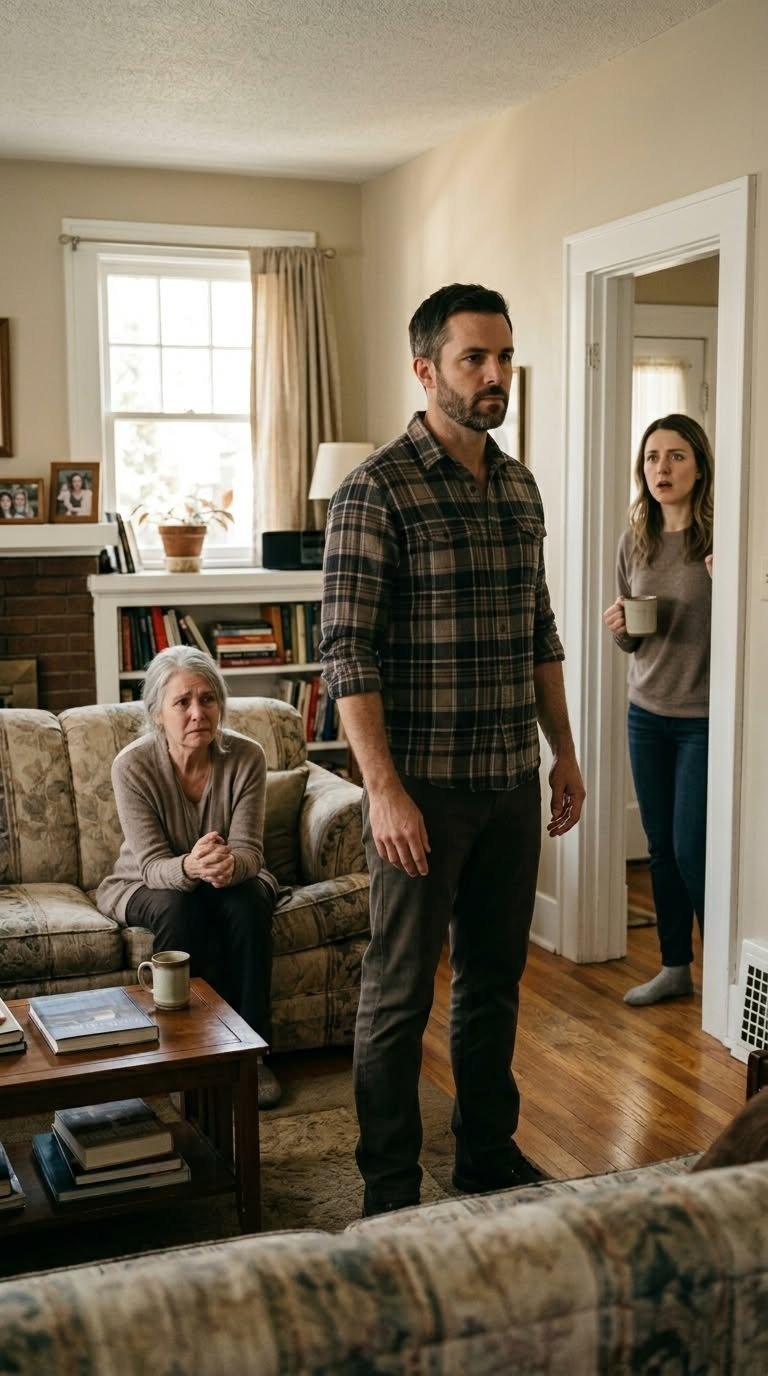
That morning, standing in the living room with your mother on the sofa and Laura framed in the doorway, you realize you no longer feel like a husband trying to save something.
You feel like a landlord preparing to evict the wrong tenant from a life she has mistaken for her own.
Laura leans one shoulder against the doorframe, one hand still wrapped around her coffee mug, her face composed in that polished way she wears whenever she thinks a conversation is about to become inconvenient rather than dangerous. She looks between you and your mother and senses the tension, but not the depth of it. Not yet.
“What changes?” she asks.
You stand slowly.
Your mother, Marta, sits very still on the sofa, hands pressed together so tightly the knuckles have gone pale. She already knows this moment matters. Mothers always know when the weather inside a room has shifted beyond ordinary argument.
You turn to Laura and speak with a calm that surprises even you.
“The kind that start with my mother never serving this house like hired help again,” you say. “And end with you explaining why she’s been eating cold rice while you sit across from her with hot food.”
Laura blinks.
That is all.
Just one blink.
But it is enough to tell you she is not shocked by the accusation itself. She is shocked that you saw it.
Then, almost instantly, the recovery comes. A soft exhale. A tiny lift of the eyebrows. The practiced expression of a woman who has spent years surviving by turning selfishness into misunderstanding and disrespect into tone issues.
“Oh, come on,” she says lightly. “Is that what this is about?”
Your mother flinches before you do.
That hurts more than it should.
Because it tells you this isn’t just about food. It is about climate. About how thoroughly your mother has learned to make herself smaller in her own home so Laura can keep feeling large. It is about the terrible habits women build when they decide peace is safer than dignity.
You keep your eyes on Laura.
“Yes,” you say. “That’s what this is about.”
Laura sets the mug down on the side table and folds her arms. “Your mother eats what she wants. If she says she’s fine, maybe stop treating her like a child.”
There it is.
The pivot.
Not denial.
Not yet.
A reframing. A clean little shift from cruelty to independence. She wants the argument to become about your overreaction, your mother’s preferences, your inability to handle normal household dynamics. She wants to widen the room until truth gets lost in interpretation.
Three years ago, that might have worked.
Today, it doesn’t.
You glance at your mother. “Did you want cold rice last night?”
Marta opens her mouth.
Stops.
Looks at Laura.
That’s all the answer you need.
You turn back.
“Did you want two tortillas and a spoonful of beans this morning while you cooked eggs and ham for my wife?”
Your mother’s eyes fill immediately. “Hijo…”
You hold up one hand, not to silence her cruelly, but to protect her from having to rescue everyone again.
Laura’s face tightens now.
Just slightly.
“You’re making this into something ugly for no reason,” she says. “I didn’t force anybody to do anything.”
The room goes silent.
Because that sentence is the sentence people like Laura always reach for when they have benefited from someone else’s submission for far too long. I didn’t force. I didn’t ask. She offered. She likes to help. She’s old-fashioned. She insists. It is the language of clean hands in dirty systems.
You have spent your whole adult life around numbers. Construction budgets, labor estimates, change orders, material loss, timing structures. You know how to look at scattered pieces and see pattern. That is why the rice hit you so hard. Not because it was dramatic. Because it was precise. It fit everything else. The restaurant charges. The shrinking grocery budget. The way your mother moved around Laura in the mornings like she was navigating around furniture that might bruise.
This wasn’t one night.
It was a design.
“I looked at the bank account,” you say.
That gets her attention.
Laura’s chin lifts a fraction. “What does that have to do with anything?”
“Enough.”
She laughs once. Sharp. “Enough what?”
“Enough restaurant bills for one person to know you’ve been feeding yourself outside this house while cutting groceries inside it.”
Your mother makes a small sound beside you. Not a word. Just pain.
Laura turns toward her immediately. “Doña Marta, please tell him this is ridiculous.”
Your mother does not answer.
The silence lands harder than any accusation.
For the first time since you came down the stairs, something real flickers across Laura’s face. Not guilt. Not shame. Fear. Because she is beginning to understand that this is not the kind of marital conflict she can charm, cry, or talk sideways into submission. You are too calm. Too finished.
She changes tactics.
“Are you seriously humiliating me in front of your mother?” she asks.
No.
That is the wrong framing entirely.
You look at her and realize, with a clarity so cold it almost feels merciful, that you no longer owe her the delicate handling reserved for beloved things.
“I’m not humiliating you,” you say. “I’m identifying a problem in my house.”
Laura straightens. “Your house?”
“My house,” you repeat. “The one I paid for. The one my mother helped keep afloat when I was still building my business. The one you’ve apparently turned into a place where she feels like she has to apologize for eating.”
You can see the insult hit.
Not because of ownership. Because of exclusion. She hears what you are really saying beneath the words. Not wife. Not partner. Not equal. Someone living here on borrowed authority.
“Wow,” she says, her voice quieter now, more dangerous. “So that’s what this is really about.”
You wait.
She steps farther into the room, and now the performance sharpens. Her eyes glisten. Her shoulders tighten. She is preparing the next version of herself, the injured one. The woman cornered by two unreasonable people and forced to defend her very character over breakfast.
“You’ve never liked that I run this household differently,” she says. “You let your mother interfere in everything, and when I finally try to create some structure, suddenly I’m the villain.”
Structure.
You almost admire the audacity.
Cold rice for your mother.
Hot meals for herself.
Silence for everyone else.
Structure.
“You call this structure?” you ask.
“What would you call it?”
You look directly at her.
“Contempt.”
That word lands in the center of the room and stays there.
Laura stares at you.
Your mother begins crying quietly.
Not loudly. Not theatrically. Just the kind of soft, contained crying that comes from women who have spent entire lives making sure nobody feels burdened by their pain. You turn immediately and sit beside her on the sofa.
“Mamá,” you say gently.
She shakes her head, wiping her cheeks too quickly. “No, hijo. Please. Don’t fight because of me.”
There it is.
That old maternal reflex.
Bleed quietly. Protect everyone else from the sight of it. Smooth the tablecloth while the house burns. You take both of her hands in yours.
“This is not because of you,” you say. “This is because I saw the truth.”
Laura exhales dramatically behind you.
And that’s the moment something inside you hardens beyond recovery.
Not because she is angry.
Because she is annoyed.
Your mother is crying in the next room over the humiliation of being made small in a house she helped build, and Laura is acting inconvenienced by the emotional noise. That tells you all that is left to know.
You stand up again.
“Mamá,” you say, still holding her gaze, “go upstairs and start packing.”
She stares at you in confusion. “But…”
“Please.”
She looks toward Laura. Then back to you. Then, because somewhere inside every tired mother there is still a woman who knows when her son has crossed into a new kind of seriousness, she nods slowly and rises.
Laura turns sharply. “Packing for what?”
You answer without looking at her. “Because she’s leaving with me.”
Your mother pauses. “Hijo, I don’t understand.”
You finally turn.
“I’ve decided we’re moving out today.”
Laura lets out a small incredulous laugh. “We?”
“You and me are not included in the same sentence anymore.”
That hits.
You see it in the way her mouth opens but no words come immediately. For the first time, her confidence misses its step. Not because she didn’t think you might yell or threaten or sulk for two days. But because she did not imagine decisiveness. People who take advantage of kindness almost never prepare for clean endings. They count on hesitation. They feed on ambiguity.
She recovers fast, of course.
“This is insane,” she says. “You’re throwing away a marriage over food?”
“No,” you reply. “I’m ending a marriage because of what the food revealed.”
Laura throws up both hands. “Oh my God. Listen to yourself.”
“I did. All night.”
She starts pacing.
The polished mask cracks now, and something uglier begins to show. Not wild evil. Not movie-villain rage. Just the ordinary fury of a person being denied access to comfort she has quietly come to believe is permanent.
“You always do this,” she snaps. “You take one little thing and turn it into some moral drama.”
You almost smile.
Because now, finally, she is telling the truth in the only language she has. One little thing. Of course it seems little to her. People who are fed rarely understand hunger as anything but temporary inconvenience. People who have never had to shrink themselves to remain welcome always underestimate the violence of small daily humiliations.
“One little thing,” you repeat. “My mother eating cold rice across from your hot dinner isn’t little.”
“She never complained.”
“That’s because decent people don’t always complain when they’re being mistreated.”
Laura laughs again, but there is no ease in it now. “So I’m abusive because I asked her to make breakfast?”
“No. You’re abusive because you got comfortable receiving service from a woman old enough to deserve rest.”
Her face goes red.
“You are unbelievable.”
“No,” you say. “I was unbelievable when I married you without seeing this.”
That one finally cuts.
The room stills.
The truth is, when you married Laura, everyone thought you had done well. She was attractive, socially graceful, clever enough at parties, perfectly turned out in every photograph. She knew how to flatter clients’ wives without seeming insincere. She knew which wine to bring, which laugh to use, how long to touch someone’s arm before it felt intimate instead of strategic. She made your life look polished. After years of grinding your way through concrete dust, payroll disasters, subcontractor headaches, and long hours, Laura looked like reward.
At first maybe she even was.
But reward is not character.
Somewhere between comfort and entitlement, she started acting less like a wife and more like a woman auditioning for aristocracy in a household with no staff budget. And because your mother is the kind of person who cannot watch another human leave a plate dirty without washing it herself, Laura found a servant where she should have found a boundary.
You see all that now.
Too clearly.
Laura crosses her arms again, but now it feels defensive rather than poised. “So what? You want me out?”
You don’t answer immediately.
Instead, you walk to the sideboard near the dining arch and pick up your keys. Your briefcase. Your phone. The legal pad you keep for job estimates. You set all three on the coffee table with care. Then you look at her.
“Yes,” you say.
The word seems to stun her more than shouting would have.
“You can’t be serious.”
“I’m very serious.”
“Over this?”
“There is no this anymore. There is only what I saw.”
She looks at your mother’s retreating figure on the staircase and then back at you, calculating fast.
“You’re choosing her over me.”
No.
That isn’t right either.
You shake your head. “I’m choosing decency over whatever this has become.”
Laura’s eyes flash. “She has always hated me.”
Your mother stops halfway up the stairs and turns, startled.
You feel something nearly laughable pass through you. Not amusement. Recognition. Of course this is where Laura goes when the center collapses. Accuse the older woman. Rewrite the household. Make your mother the difficult one. The meddling one. The manipulator hiding behind frailty.
But the timing is terrible for her. You have spent the last twelve hours auditing behavior with the ruthless clarity of a man whose love has finally lost its illusions. The old tricks arrive too late now. You can see the seams.
“My mother hated the idea of burdening anyone,” you say. “That’s why you got away with this.”
Laura stares at you.
“You have one hour,” you continue. “Pack what belongs to you. I’ll call a car service if you want, or your sister can come get you.”
Her jaw drops.
“One hour?”
“Yes.”
“This is my home too.”
“No,” you say quietly. “It was your chance to have one.”
That is the cruelest thing you say all day.
It is also the truest.
Laura starts crying then.
Real tears this time, or real enough. Panic can produce sincerity even in people who spend most of life performing. She steps toward you quickly.
“Please,” she says. “We can talk about this. You’re upset. Fine. I get it. I should have been more thoughtful. I’m sorry. Okay? I’m sorry.”
Maybe in another version of this morning those words would matter.
If they had arrived six months ago. Three months ago. Yesterday. Before the rice. Before the bank statements. Before the sight of your mother moving through her own kitchen like a guest hoping not to overstay.
Now they feel less like remorse and more like a hand reaching for the last floating board after the ship has already gone down.
You hold her gaze.
“I believe you’re sorry I found out.”
That lands exactly where it should.
Laura’s crying sharpens. “That’s cruel.”
“Yes,” you say. “It is.”
She searches your face for some remaining softness.
Finds none.
People rarely understand how frightening calm can be until they meet someone whose disappointment has settled beyond persuasion. You are not screaming. You are not punishing her for effect. You are done. And done, when it is real, has a silence to it that terrifies people more than rage ever will.
Laura wipes under her eyes hard enough to smear mascara.
“This is because you’ve always felt guilty about your mother being alone,” she says. “You project that onto me. You let her guilt you. You let her make you feel like you owe her your whole life.”
The words hit the air like poison.
Your mother, still on the stairs, goes motionless.
Something changes in you then.
You cross the room so fast Laura actually steps back.
“Do not,” you say softly, “speak about my mother that way in front of me again.”
The softness is what makes her pale.
She has seen you angry before. Loud. Frustrated. Tired after job site disasters or late payments or tax-season headaches. But she has never seen this version. The one who speaks quietly because the verdict is already signed.
For a second, you think she might keep fighting.
Then something in your face convinces her otherwise.
Without another word, she turns and goes upstairs.
The sound of the bedroom door slamming echoes through the house.
Your mother comes down one step, then another, uncertain. “Hijo…”
You go to her immediately.
“No,” she says, shaking her head, tears starting again. “No, don’t do this because of me. A woman’s marriage is sacred.”
You almost break at that.
Because there it is. The generation gap wrapped in one sentence. Your mother, who has endured more than you fully know, still treating marriage as something holy even when it becomes the place where her dignity is rationed like leftovers. She would rather shrink forever than be the reason your home falls apart.
You take her shoulders gently.
“Mamá, listen to me.”
She does.
“This marriage didn’t break today. Today I finally saw it.”
Her lips tremble.
“She’s my wife,” she says weakly.
“No,” you reply. “A wife protects a home. She doesn’t use it like a ladder.”
Your mother closes her eyes.
Then, very quietly, “I didn’t want you to think badly of her.”
The sentence tears something open in you.
Of course she didn’t.
That’s exactly who Marta has always been. The kind of woman who would rather eat cold rice than risk staining someone else’s image. She probably spent months softening Laura in her own mind, translating selfishness into tiredness, translating disrespect into generational difference, translating neglect into one of those things marriages survive if good women stay patient.
Good women save too many people from consequences.
“Go pack,” you say again, gentler now. “We’re leaving.”
This time she obeys.
You stay downstairs.
Not because you are afraid Laura will steal something or stage a scene. Because you need the stillness. The house feels different already, as if it has exhaled a long-held lie. Morning light creeps farther across the tile. The smell of eggs and coffee has turned stale. Somewhere in the distance a neighbor’s radio hums an old ranchera, tinny through an open window.
You sit at the dining table and open your laptop again.
There are practical matters now.
That is another thing people don’t tell you about endings. The moment the emotional truth arrives, paperwork follows with ugly little shoes. Mortgage allocation. Utility accounts. Insurance. The small mechanics that continue clicking long after the heart has already decided. You transfer half the liquid household buffer into an account Laura cannot touch. Freeze the secondary card. Email your lawyer. Type one sentence.
Need to begin immediate separation proceedings. Today.
He responds six minutes later, because divorce attorneys are vultures with calendars.
Call me when free.
You close the screen.
When Laura comes downstairs forty-five minutes later, she is dressed as if for battle. Makeup repaired. Hair smoothed. Two large suitcases behind her. The crying is gone. In its place is something icier and more familiar. Pride reassembled under pressure.
Good.
In a strange way, you prefer this version.
It saves everyone the trouble of pretending.
She stops near the entryway and looks around the house slowly, almost theatrically, as if memorizing the setting for later use when she tells the story of your cruelty to friends who have only ever seen her at brunch.
“So that’s it,” she says.
“Yes.”
“You’re throwing me out.”
“I’m ending this marriage.”
“Because your mother skipped meat a few times.”
No.
Still no understanding.
Or maybe understanding, but refusal to name it.
You stand.
“Because I no longer trust the kind of person who could sit across from an old woman eating cold rice and not feel sick.”
Laura actually laughs.
“You’re unbelievable. Do you know how dramatic this sounds?”
“Maybe.”
“You’ll regret this.”
That line should feel stronger. It doesn’t.
Because regret belongs to people who still wish the illusion had worked.
You are past that now.
What you feel is cleaner.
Sadder, maybe. But cleaner.
“No,” you say. “I regret not seeing it sooner.”
Her nostrils flare. “You think you’re some noble son all of a sudden? Where was all this righteousness when your mother was folding your laundry and making your coffee for years?”
Interesting.
You nod once.
“There,” you say. “That right there. That’s exactly what I mean.”
Laura frowns.
“She was never part of this family to you,” you continue. “She was labor. Older labor, quieter labor, guilt-resistant labor. You just got comfortable.”
For the first time all morning, Laura has no immediate comeback.
You pick up your keys and open the front door.
Her suitcases sit by the threshold like punctuation marks.
“You can wait on the porch,” you say. “Your sister will be here in ten minutes.”
“How do you know I called my sister?”
“You always call Carla when you need an audience.”
Her face hardens.
Then she does something you should have expected.
She goes for the one weapon she thinks might still cut.
“You’ll end up alone,” she says. “With your mother. In that sad little loyalty prison you built for yourself.”
The words hang there.
Ugly.
Sharp.
Designed to wound.
And for one tiny second, they do.
Not because you fear being with your mother.
Because you realize how thoroughly Laura mistook devotion for weakness. How many times she must have looked at your care for Marta and translated it not into love, but into exploitable guilt. That kind of misreading doesn’t happen overnight. It grows in people who have never really respected tenderness unless it could be redirected toward themselves.
You step aside from the doorway.
“Leave.”
She looks at you.
Something flickers.
Maybe hope that you’ll soften.
Maybe disbelief that you won’t.
Then, without another word, she drags her suitcases across the tile, out through the door, and onto the porch.
The sound of the wheels rattling over the threshold is unexpectedly satisfying.
You close the door.
And the house goes quiet.
Not peaceful.
Not yet.
But quieter in an honest way.
Ten minutes later, Carla arrives in a silver SUV and spends exactly ninety seconds at the door calling you ungrateful, insane, manipulated by your mother, impossible to please, and too attached to the past. You let her speak. It costs you nothing. People like Carla need volume the way certain birds need shiny objects.
When she runs out of steam, you say, “Take her home.”
Carla glares.
“You think this makes you a man?”
“No,” you answer. “I think it makes me late.”
That confuses her enough to end the performance.
They leave.
And suddenly, just like that, it’s over.
Or at least the visible part is.
Your mother comes downstairs with two small suitcases and a plastic bag full of folded aprons.
That nearly destroys you.
“Why are you taking the aprons?” you ask.
She looks embarrassed. “They’re mine.”
Of course they are.
You take them from her gently and set them aside.
“You won’t need those where we’re going.”
She looks around the house, uncertain. “Where are we going?”
You smile for the first time that day.
“My place near the river.”
Her eyes widen. “The apartment?”
“It’s bigger than an apartment.”
This is true. Two years ago, when work began going well enough to reward yourself without feeling reckless, you bought a quiet one-story condo overlooking the riverwalk on the edge of the city. You told everyone it was for convenience when projects kept you late. A place to crash between job sites and client meetings. Laura hated it because it was too simple, too practical, too far from the version of life she liked performing. She went there twice, complained about the lighting, and never returned.
You kept it anyway.
Good thing.
By noon, you and Marta are there.
The condo smells faintly of cedar cleaner and the coffee beans you keep in airtight jars because you are old enough now to afford small preferences. Sunlight spills across the open living room. There is a balcony overlooking the water. A kitchen with clean counters, real food, and exactly zero tension in the air.
Your mother stands in the doorway holding her handbag like a guest unsure whether she should remove her shoes.
“It’s beautiful,” she whispers.
You put her suitcase in the spare bedroom.
“No,” you say. “It’s ours.”
That undoes her.
She starts crying again, harder this time, and covers her face with both hands. You go to her quickly and hold her the way you haven’t since you were a boy. Small. Tired. Braver than the world ever had a right to demand. She shakes against your chest and keeps saying the same thing over and over.
“I’m sorry. I’m sorry.”
You close your eyes.
“Mamá,” you murmur, “stop apologizing for surviving in my house.”
That afternoon, you cook.
Poorly, but sincerely.
Chicken soup. Rice with vegetables. Warm tortillas wrapped in a clean towel. You make enough for leftovers, enough for tomorrow, enough to flood the new kitchen with the kind of smell no one can mistake for neglect. Marta tries to stand and help. You forbid it. She sits at the small dining table instead, watching you the way mothers watch sons who have finally become the men they were always hoping lived underneath the noise.
When you set the bowl in front of her, steaming and fragrant, she stares at it for a moment longer than necessary.
Then she looks up at you with eyes still swollen from crying.
“It’s too much,” she says.
No.
That word almost breaks you again.
Because now you understand the damage more fully. Not just that she was being fed badly. That she had been taught, meal by meal, to think comfort was excess. Warmth was extra. Care was too much. One of the cruelest things you can do to a person is make them feel unreasonable for having ordinary human needs.
You sit across from her.
“It’s dinner,” you say.
She nods.
But before she lifts the spoon, she does something that humbles you more than any sermon ever could. She bows her head and whispers grace. Not long. Just enough to thank God for food, for shelter, and for sons who come home when they are supposed to.
You have to look away for a second.
That night, after she goes to sleep in the guest room, you stand alone on the balcony.
The river below catches city light in broken ribbons. Somewhere farther down, a couple is laughing near the walking path. Traffic hums. Wind moves gently through the trees. You should feel triumphant, maybe. Or devastated. Or furious enough to call three friends and narrate the whole collapse.
Instead you feel tired in a way deeper than sleep.
Because endings, even righteous ones, still cost something.
You loved Laura once.
Maybe not in the grand, cinematic way people describe in toasts and anniversary captions. But enough. Enough to trust her around your mother. Enough to build routines, buy furniture, share passwords, split holidays, discuss paint colors, imagine years. That deserves mourning too, even when the person you mourn turns out to have loved comfort more than kindness.
You stay on the balcony until your phone buzzes.
Laura.
Of course.
The first text is short.
You’re overreacting.
The second arrives before you even unlock the first.
Carla says you calmed down before. You’ll calm down again.
Then:
We need to talk when your mother isn’t in your ear.
That one actually makes you laugh.
You type only six words.
My mother never had to speak.
Then you block her number.
The next days are administrative war.
Laura alternates between rage and strategy. One day she wants reconciliation. The next she wants compensation. Then indignation. Then insult. Then a version of events in which your mother manipulated you because she was jealous of Laura’s place in your life. Your lawyer, a compact woman named Teresa who enjoys difficult truths the way sommeliers enjoy tannins, dismantles each attempt with frightening efficiency.
There are no children.
No shared property in her name.
No serious grounds for contesting the separation beyond noise.
What Laura does have is social skill and a talent for rearranging stories. For a few weeks, that creates a small storm. Mutual friends call. Her cousin posts vague things online about ungrateful men choosing their mothers over their wives. One woman from church, who always smelled faintly of roses and judgment, corners you after Sunday mass to say marriage requires patience through “domestic misunderstandings.”
You look her dead in the face and say, “If your mother were eating cold rice in front of your hot dinner, would you call that a misunderstanding?”
She never brings it up again.
Through all of this, Marta remains painfully gentle.
Too gentle.
She keeps trying to excuse Laura even from a different address. “She is young,” she says. “Young people do not always know how to share a house.” Or, “Maybe I spoiled her by doing too much.” Or worst of all, “Perhaps I should have asked for more.”
That last one makes you put down your coffee cup so hard it nearly cracks.
“No,” you say.
She startles.
“You should not have had to ask for basic respect.”
Marta lowers her eyes.
And you realize how thoroughly women of her generation were trained to phrase their suffering like a personal administrative error. As if the problem was not that someone took advantage of them. The problem was that they failed to submit a request in triplicate.
So you begin correcting her gently.
Every time.
No, you were not too sensitive.
No, you were not asking for too much.
No, kindness is not a license others can redeem for labor.
No, being older does not make your hunger smaller.
It takes weeks.
But slowly, the language changes.
One evening, about a month after moving in, you find her in the kitchen reheating soup without first asking whether you already had plans for dinner.
That tiny act nearly feels historic.
“You didn’t wait for me,” you say.
She looks up nervously, then catches herself.
“I was hungry,” she says.
The sentence is so simple.
So ordinary.
And yet it rings through the whole room like a bell.
Good, you think.
Good.
You make a life.
Not a glamorous one. Not a tragic one either. Just a truer one. Marta fills the balcony with potted herbs and sits in the morning light shelling peas she insists taste better fresh. You work. Come home earlier more often. Learn how to cook three decent meals without supervision and one excellent mole after seven failed attempts and a humiliating phone consultation with your sister Elena. On Sundays you bring your mother flowers from the market, not because she asks, but because her face changes when she sees them in a vase by the window.
Months pass.
The divorce finalizes cleanly.
Laura remarries fast, which surprises no one and hurts you less than you expect. A man from Guadalajara with a dental chain and a boat. Good for her, maybe. Some people only ever wanted comfort arranged more tastefully. Some marriages end not because there was no love, but because one person kept calling appetite a personality.
You stop talking about her.
That is its own mercy.
Then, in late autumn, something happens that undoes you in an entirely different way.
You come home on a Thursday evening carrying takeout from the Lebanese place Marta likes, and you hear her laughing before you open the door.
Really laughing.
Not polite laughter. Not social. Deep, delighted, unguarded laughter from the living room. When you step inside, she is sitting on the couch with your niece Camila, who has come by after university, and the two of them are arguing cheerfully over a telenovela plot twist like the women in this family used to when life was still crowded but safe.
Marta looks up and sees you.
Her face lights.
Not carefully.
Not apologetically.
Lights.
And that’s the exact moment you realize the house isn’t just calmer without Laura.
It is alive again.
Later, after Camila leaves and you and your mother eat warm food at the table while the rain taps softly against the windows, she says something that stays with you forever.
“You know,” she says, spoon halfway to her mouth, “for a while I thought maybe I was becoming invisible.”
You freeze.
She keeps her eyes on the soup.
“Old women disappear slowly,” she says. “Not all at once. First people stop asking if you’re tired. Then they stop asking if you’ve eaten. Then they stop seeing whether you’re sitting or standing. One day you realize they only notice you when something needs to be done.”
The words hit with the slow force of a truck rolling downhill.
You set your spoon down.
“Mamá…”
She lifts one shoulder. “It happens.”
No.
That is the tragedy.
That she can say it so simply.
Like weather.
Like aging itself naturally includes being reduced to usefulness.
You reach across the table and cover her hand with yours.
“Not anymore,” you say.
She smiles.
This time, her eyes match it.
Years later, people will ask what ended your marriage.
Some will want drama.
Infidelity, maybe. Violence. Some sensational betrayal big enough to justify the clean cut you made. People are oddly suspicious of endings born from quiet contempt. They like their disasters obvious. Easier to admire from a distance.
You usually tell them the truth anyway.
I came home three days early and found my mother eating cold rice.
That is enough.
Because anyone with sense understands the rest.
The way a house reveals its moral center not in speeches, but in meals. In who gets served first. In who eats warm and who eats leftovers. In whose hunger matters enough to be seen without a request form attached.
That morning in the yellow kitchen, there were no screams.
No shattered plates.
Just a bowl of cold rice, a plate of hot meat, and the soft tapping of a spoon against ceramic.
Tac.
Tac.
Tac.
Sometimes that is all it takes to hear the truth.
And if anyone ever asks when you knew your marriage was over, you won’t say it happened when Laura argued, cried, or rolled her suitcases across the threshold.
You knew earlier than that.
You knew the moment you looked at your mother’s eyes and recognized the expression of someone trying not to inconvenience her own pain.
That was the real ending.
Everything after that was just you finally having the courage to serve it warm.
THE END