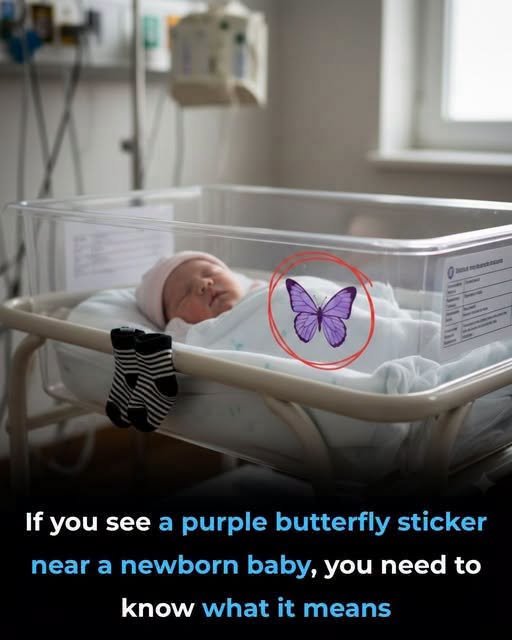
The Purple Butterfly That Helped Grieving Parents Feel Seen
One mother’s innocent remark reopened a wound Millie Smith could barely bear. Her surviving daughter lay in intensive care, while the twin who had lived for just three hours was gone. Then a few devastating words inspired a quiet symbol that would help other grieving parents feel seen without having to explain their deepest heartache to every new stranger.
Millie Smith and her partner, Lewis Cann, were eagerly preparing to welcome twins when their lives took an unexpected turn. During pregnancy, doctors discovered that one of their daughters had anencephaly, a serious birth defect in which significant portions of the brain and skull do not develop. The condition meant their little girl would survive only a short time after birth.
Despite the heartbreaking news, Millie continued her pregnancy. She wanted to cherish every moment with both daughters, knowing that even a brief life could hold immeasurable meaning.
They named the baby Skye, choosing a name that would always give them somewhere to look when they wanted to remember her.
Her twin sister, Callie, was still growing alongside her, and Millie held on to the hope of bringing both girls into the world surrounded by love.
Then, at just 30 weeks into the pregnancy, labor began unexpectedly.
Both babies were delivered prematurely. In a moment Millie and Lewis would remember for the rest of their lives, both girls cried when they were born.
For a brief, precious time, they were both here.
Millie held Skye close, knowing that every second together mattered. She tried to absorb the tiny details of her daughter’s face, her warmth, and the reality that she was finally able to hold the baby she had carried for months.
Three hours later, Skye died in her mother’s arms.
The grief was indescribable. Millie and Lewis had lost a daughter, but their other baby, Callie, was still alive and needed intensive neonatal care.
They were forced to navigate two very different experiences at once: mourning one child while desperately hoping the other would grow stronger.
Inside the neonatal intensive care unit, their world revolved around Callie’s treatment, medical updates, and the uncertainty that comes with having a premature baby.
But there was another challenge Millie had not anticipated.
The outside world did not always understand that she was both a mother of twins and a grieving mother.
The comment that changed everything
While Callie was receiving care, Millie encountered another mother who made an innocent comment about being lucky not to have twins.
The woman did not know what Millie had endured. She could not have known that Millie had given birth to twins or that one of her daughters had died only hours after birth.
But the remark cut deeply.
Millie was already carrying the pain of losing Skye while trying to remain strong for Callie. Hearing someone describe not having twins as good fortune made her feel that the daughter she had lost was invisible.
The other mother had not intended to hurt her. That was part of what made the experience so difficult: people could cause pain without realizing it, simply because they did not know the full story.
Millie understood that she could not explain her loss to every person who entered the neonatal unit. She also realized that other families who had lost one twin might face the same painful misunderstandings.
She began thinking about how hospitals could communicate that a surviving baby had a sibling who had died.
Parents should not have to repeatedly tell strangers about their loss just to prevent an insensitive comment.
There had to be a gentler way.
The little purple butterfly
Millie came up with a simple but powerful idea: a purple butterfly sticker placed on the incubator of a baby whose twin or multiple-birth sibling had died.
The butterfly would quietly communicate something deeply important.
This baby had a sibling.
That sibling mattered.
And the family was carrying a loss that might not be immediately visible to anyone walking into the room.
Purple was chosen as a color that could represent all babies lost from a multiple pregnancy, regardless of their sex.
The symbol was small, but its meaning was enormous.
For grieving parents, it offered recognition without requiring an explanation. For nurses, doctors, and other visitors, it served as a gentle reminder to approach the family with greater awareness and sensitivity.
A simple sticker could help prevent a painful question or an unintended remark. More importantly, it could acknowledge that the child who had died remained part of the family’s story.
Skye had lived for only three hours, but she was Callie’s twin sister. She was Millie and Lewis’s daughter, and she would always be remembered.
The butterfly helped make that truth visible.
From personal heartbreak to a message of hope
Millie’s idea gradually spread beyond her own experience. Hospitals began using purple butterfly symbols to identify babies whose multiple-birth siblings had died.
The initiative became associated with the Skye High Foundation, established in memory of Skye to raise awareness of baby loss and support families experiencing the death of a baby from a multiple pregnancy.
The foundation’s work helped bring attention to a particular kind of grief that can be difficult for others to recognize: losing one baby while continuing to care for another.
These parents may be celebrating a surviving child’s progress while simultaneously grieving the sibling who is missing. They may feel gratitude, fear, love, and heartbreak all at once.
There is no contradiction in those emotions.
A family can be thankful that one baby survived and devastated that another did not. A surviving twin’s milestones can bring joy while also reminding parents of the moments they will never share with the child they lost.
The purple butterfly does not remove that pain. It does something quieter and perhaps just as important: it tells parents that they do not have to pretend the loss never happened.
Why the butterfly matters
For many grieving families, one of the hardest experiences is feeling that their lost baby has been forgotten by everyone except them.
Friends and strangers may not know what to say. Some may avoid mentioning the baby altogether because they are afraid of causing more pain. Others may make casual comments without understanding the family’s circumstances.
Yet acknowledging a baby who has died does not have to be complicated.
Sometimes it means using the baby’s name. Sometimes it means listening without trying to fix the grief. And sometimes, in a hospital, it means noticing a tiny purple butterfly and understanding that a family may need extra gentleness.
The butterfly also reminds healthcare professionals that bereavement and neonatal care can happen at the same time. Parents may need support for their surviving child while also needing space to mourn the one they lost.
Both experiences deserve compassion.
Skye’s legacy
Millie and Lewis could never have imagined that their daughter’s brief life would inspire a symbol recognized by families and medical teams in different parts of the world.
Skye’s time on earth was heartbreakingly short, but her memory helped create a way for other parents to have their losses acknowledged.
The purple butterfly became more than a mark on an incubator. It became a reminder that every baby matters, that grief deserves recognition, and that kindness often begins with understanding what someone else may be carrying.
Millie’s story also offers a lesson for all of us.
We rarely know the full story behind another person’s circumstances. A comment that seems harmless to us may touch a wound we cannot see. We may never know whether someone sitting beside us is celebrating, grieving, or somehow doing both.
That is why a little more patience, a little more sensitivity, and a willingness to listen can make such a difference.
Skye lived for three hours, but she was loved for a lifetime.
And through the purple butterfly, her memory continues to remind the world that a baby does not have to live long to matter, and a loss does not have to be visible to deserve compassion. 💜