The judge had asked Tyler where he wanted to live.
I had sat perfectly still, my hands folded tightly in my lap, trying to look brave for the boy who had been my entire world since the day he was born.
Tyler stared at the floor for several seconds. Then he looked toward his father, Harrison, who sat in an expensive suit beside his attorney.
Finally, my son spoke.
“I want to live with my dad.”
The words were quiet, but they landed like a door slamming shut.
I remember the judge asking Tyler whether he understood what he was saying. My son nodded. I remember Harrison placing a reassuring hand on Tyler’s shoulder. And I remember the strange expression on Tyler’s face—not happiness, not relief, but something closer to fear.
I wanted to stand up and ask him why.
Why would he choose a man who had been absent for so many years over the mother who had been there for every scraped knee, every fever, every nightmare?
But I didn’t ask.
I wouldn’t make my child defend himself in a courtroom full of strangers.
When the hearing ended, Harrison’s attorney began discussing arrangements for Tyler to move into his father’s home. Harrison had a beautiful house, a private school lined up, and plans for Tyler’s future that sounded impressive when described in legal language.
I had a small apartment, a modest income, and a lifetime of memories that suddenly seemed to count for very little.
Tyler approached me before leaving.
His eyes were red, although he tried to hide it.
“Mom,” he whispered.
I pulled him into my arms.
For one brief moment, he held me so tightly that I thought he might change his mind.
Then he slipped something into my coat pocket.
“Keep this,” he murmured. “Please don’t look at it until you’re alone.”
I pulled back, confused.
“What is it, sweetheart?”
“Just promise me.”
I promised.
Then he kissed my cheek, turned away, and walked toward his father.
I watched him leave the courthouse without looking back.
Seven days later, I was in a taxi heading away from the airport, holding that mysterious black card in my hand.
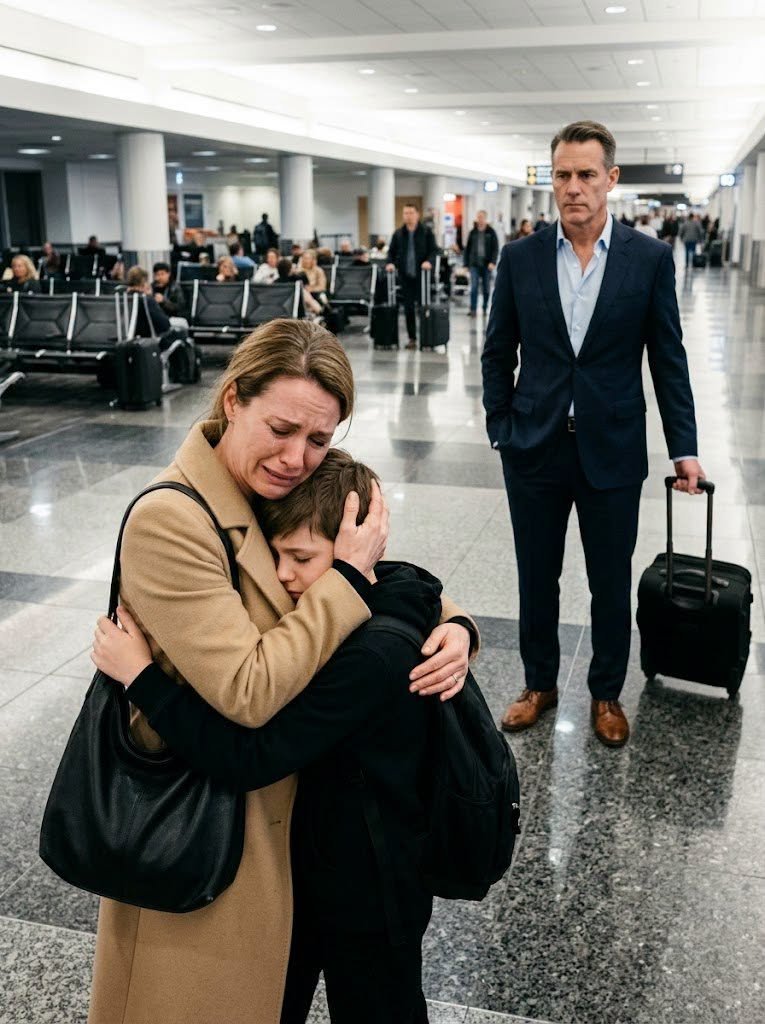
Harrison had arranged for Tyler to leave town with him immediately after the court proceedings. I had gone to the airport to say goodbye, hoping for a few extra minutes with my son before they boarded their flight.
Tyler had barely spoken during our final embrace.
But just before he walked away, he squeezed my hand and whispered, “Remember what I told you.”
Then he was gone.
Now, alone in the taxi, I turned the black card over in my fingers.
There was a small silver symbol in one corner and a series of numbers printed along the bottom. On the back, in Tyler’s familiar handwriting, were five words.
“Ask Grandma about the blue box.”
I read the sentence again.
Tyler’s grandmother, Eleanor, was Harrison’s mother. She had always been polite to me, but our relationship had grown distant after Harrison and I separated. She lived in a large house on the outskirts of town and rarely involved herself in our disagreements.
Why would Tyler send me to her?
And what was the blue box?
I called Eleanor as soon as I arrived home.
She answered after the third ring.
“Hello?”
“It’s me,” I said. “I need to ask you something about Tyler.”
There was a long silence.
Then she asked, “Did he give you the card?”
My stomach tightened.
“You know about it?”
“I was hoping he would.”
Her voice trembled.
“Can you come over tomorrow morning? There’s something you need to see.”
I barely slept that night.
Memories of Tyler filled every corner of my apartment. His sneakers were still beside the front door. His favorite mug sat on the kitchen counter. A half-finished school project rested on the dining table, waiting for the boy who would never come home that evening.
I kept thinking about his face in court.
The fear I’d mistaken for indifference.
The way he’d held me before walking away.
Perhaps I’d been so overwhelmed by the pain of losing him that I hadn’t noticed he was hurting too.
The next morning, I drove to Eleanor’s house.
She was waiting at the door, dressed in a pale blue cardigan. She looked older than I remembered, and there were dark circles beneath her eyes.
Without saying much, she led me upstairs to a small study at the end of the hallway.
A wooden box sat on the desk.
It was painted blue, with chipped corners and a brass lock.
Eleanor placed a key beside it.
“Tyler found this in his father’s office several months ago,” she explained. “He brought it to me because he was frightened by what he’d discovered.”
I stared at the box.
“What’s inside?”
“Documents. Letters. Financial records.”
She took a deep breath.
“And evidence that Harrison has been lying to both of you.”
My legs suddenly felt weak.
“What do you mean?”
Eleanor unlocked the box and lifted the lid.
Inside were folders filled with paperwork, several envelopes, and a small digital recorder.
She handed me the first folder.
The documents showed that Harrison had been preparing for a custody dispute long before he officially filed for one. He had hired consultants, collected information about my finances, and arranged for evaluations intended to make him appear to be the more suitable parent.
That alone was upsetting, but it wasn’t the worst part.
Several pages suggested that Harrison had been planning to relocate Tyler to another state and enroll him in a private school without discussing the details with me.
There were also copies of messages between Harrison and his attorney concerning the custody case.
One sentence made my blood run cold.
The boy needs to understand that his mother’s financial situation limits his opportunities. Once he sees what he could have with me, the decision should be straightforward.
I set the paper down.
“He said this about his own son?”
Eleanor nodded slowly.
“Tyler saw some of these documents. He was never supposed to find them.”
I looked at the digital recorder.
“What is that?”
“Something Tyler asked me to keep safe.”
She pressed a button.
At first, there was only static.
Then I heard Harrison’s voice.
He was speaking to someone on the phone, and his tone was colder than I’d ever heard it.
“Once the custody arrangement is finalized, she’ll have very little say in where he goes. Tyler will understand eventually. Children adapt.”
Another voice responded, too faint to make out.
Harrison continued.
“The important thing is getting him away from all this. She can’t offer him the future I can.”
The recording ended abruptly.
I sat motionless.
Harrison had always been ambitious. He believed money could solve almost any problem, and after our marriage fell apart, he’d often criticized me for not earning enough or giving Tyler the lifestyle he deserved.
But I’d never imagined that he would turn our son’s future into a competition.
“Why didn’t Tyler tell me?” I whispered.
Eleanor sat beside me.
“Because he was afraid.”
“Of his father?”
“Of what would happen if he spoke up.”
She explained that Tyler had overheard arguments between Harrison and his attorney. He had discovered that his father was determined to win custody and believed that, once he did, he could make every major decision about Tyler’s life.
Tyler was thirteen. He understood enough to recognize that something was wrong, but he was still a child trying to navigate a conflict created by adults.
He feared that if he openly challenged his father, the situation would become even worse.
“So he chose to live with Harrison because he thought it would protect me?” I asked.
Eleanor nodded, tears gathering in her eyes.
“Tyler believed his father would stop fighting you once he got what he wanted. He thought that if he went willingly, you wouldn’t have to endure another long court battle.”
I covered my mouth.
My son had stood in a courtroom and broken my heart because he thought it was the only way to protect me.
He had carried a burden that should never have belonged to him.
Eleanor reached into the box and pulled out a sealed envelope.
“There’s something else.”
My name was written across the front.
I recognized Tyler’s handwriting immediately.
With shaking fingers, I opened it.
Mom,
I’m sorry about what happened in court. I know you think I chose Dad because he has more money and because I want the life he can give me.
That’s not why.
I heard Dad talking about the case. I found the papers in his office, and I know he’s trying to make it look like you can’t take care of me.
I didn’t want him to keep hurting you. I thought if I went with him, maybe he’d stop trying to prove that you’re not good enough.
Please don’t think I stopped loving you.
You’re the person who stayed when everything was hard. You’re the one who taught me how to ride a bike, helped me with math, and sat outside my room when I couldn’t sleep.
I remember all of it.
The black card is connected to the account Grandma helped me set up when I was younger. She kept the information because she didn’t want Dad to control everything I might need someday. There’s enough there to help you speak to a lawyer and find out what you can do.
I didn’t want you to have to fight him with nothing.
I know I’m only thirteen, and maybe I don’t understand everything. But I do know that you deserve to be treated fairly.
I love you, Mom.
Please don’t give up on me.
Tyler.
By the time I reached the end, I could barely see the page through my tears.
I pressed the letter against my chest and cried in a way I hadn’t allowed myself to cry since the day of the hearing.
Eleanor held my hand.
“He loves you,” she said. “He has never stopped.”
I wanted to call Tyler immediately, but Eleanor gently stopped me.
“We need to be careful. He’s still living with his father, and we don’t know how Harrison will react if he discovers what Tyler found.”
For the first time since the courthouse, I forced myself to slow down and think.
My son had tried to protect me, but that didn’t mean I should rush into another confrontation without understanding the situation.
I contacted a family-law attorney and showed her the documents, the recording, and Tyler’s letter. She explained that the evidence needed to be reviewed carefully and that any next steps would have to follow the court’s orders and applicable law.
The black card, she discovered, was not a magical solution to our problems. It provided access to a modest account established for Tyler’s future, with Eleanor’s help. Its precise terms and permitted uses needed to be verified before any money could be accessed.
But it gave us a starting point.
More importantly, the documents and messages raised questions that deserved a proper legal review.
My attorney advised me not to contact Harrison with accusations before we understood the full picture. She also reminded me that Tyler’s wishes mattered, but his emotional safety and best interests had to remain at the center of any custody decision.
For the first time in days, I felt something other than helplessness.
I had a direction.
Over the following week, my attorney began reviewing the evidence and determining the appropriate way to raise the concerns with the court. Eleanor agreed to cooperate and explain what she knew.
I also wrote Tyler a letter.
I told him I understood why he had been frightened. I told him he was not responsible for protecting me from his father’s decisions or managing the conflict between us.
Most importantly, I told him that he never had to earn my love by sacrificing his own happiness.
I didn’t know when he would read it.
I only hoped he would understand.
Several days later, my phone rang.
It was an unfamiliar number.
“Mom?”
I knew his voice immediately.
“Tyler?”
“Hi.”
For a few seconds, neither of us spoke.
Then I heard him take a shaky breath.
“Did you get the letter?”
“Yes, sweetheart. I got it.”
“Are you mad at me?”
The question broke my heart all over again.
“No,” I said firmly. “I’m not mad at you. Not even a little.”
“I thought you’d hate me for choosing Dad.”
“Oh, Tyler.”
I closed my eyes.
“I could never hate you for being scared. I could never hate you for trying to do what you thought was right.”
He began to cry.
“I didn’t know what else to do.”
“You don’t have to solve this by yourself,” I told him. “You’re my son. You’re allowed to be thirteen. The grown-ups need to take care of the grown-up problems.”
He sniffled.
“Grandma said you’d understand.”
“I do understand. And I need you to understand something too.”
“What’s that?”
“You never have to choose between loving your father and loving me. You don’t have to protect me by giving up your own voice. You can love both of us, and you can tell the truth about how you feel.”
There was a long pause.
Then he whispered, “I miss you.”
I pressed my hand over my mouth.
“I miss you too, baby.”
We talked for several minutes, keeping the conversation focused on how he was doing and reassuring him that he could reach out when he needed support. I didn’t ask him to repeat what he’d heard or demand that he make another choice.
Before hanging up, he said something I would remember for the rest of my life.
“I just wanted you to know that I didn’t forget everything you did for me.”
I looked around my quiet apartment, at the shoes by the door and the mug on the counter.
“You never have to prove that to me,” I said. “I know who you are, Tyler. And I know you love me.”
After the call, I sat by the window for a long time.
The custody dispute was not magically resolved. There would be more difficult conversations, more legal questions, and decisions that could not be made overnight. I didn’t know exactly how things would turn out.
But I finally understood what my son had been trying to tell me.
That black card hadn’t been a promise that money could defeat money.
It had been Tyler’s way of saying that he trusted me enough to ask me to keep going.
For seven days, I’d believed my son had chosen a better life and left me behind.
Now I knew that he had been frightened, overwhelmed, and desperately trying to protect the one person he thought might be hurt by the battle between his parents.
He should never have had to carry that responsibility.
But his letter reminded me that, even in the middle of a painful family conflict, our bond had not disappeared.
It had simply been hidden beneath fear, silence, and a decision no thirteen-year-old should have felt forced to make.
I placed Tyler’s letter inside the drawer beside my bed, where I could read it whenever the loneliness became too much.
Then I looked at the black card resting on the table.
It was still plain. Still silent. Still without a name or explanation.
But it no longer represented the moment my son walked away.
It represented the moment I began to understand him.
And I made myself a promise.
I would fight for my relationship with my son, but I would not ask him to fight my battles for me. I would seek the truth, follow the legal process, and give him the one thing he had been trying so hard to protect.
The freedom to be a child who was loved by his mother, without conditions, without guilt, and without having to choose sides.
Because sometimes, a child who appears to walk away is not abandoning you at all.
Sometimes, he is simply hoping you will understand why he had to take that step—and love him enough to help him find his way home.